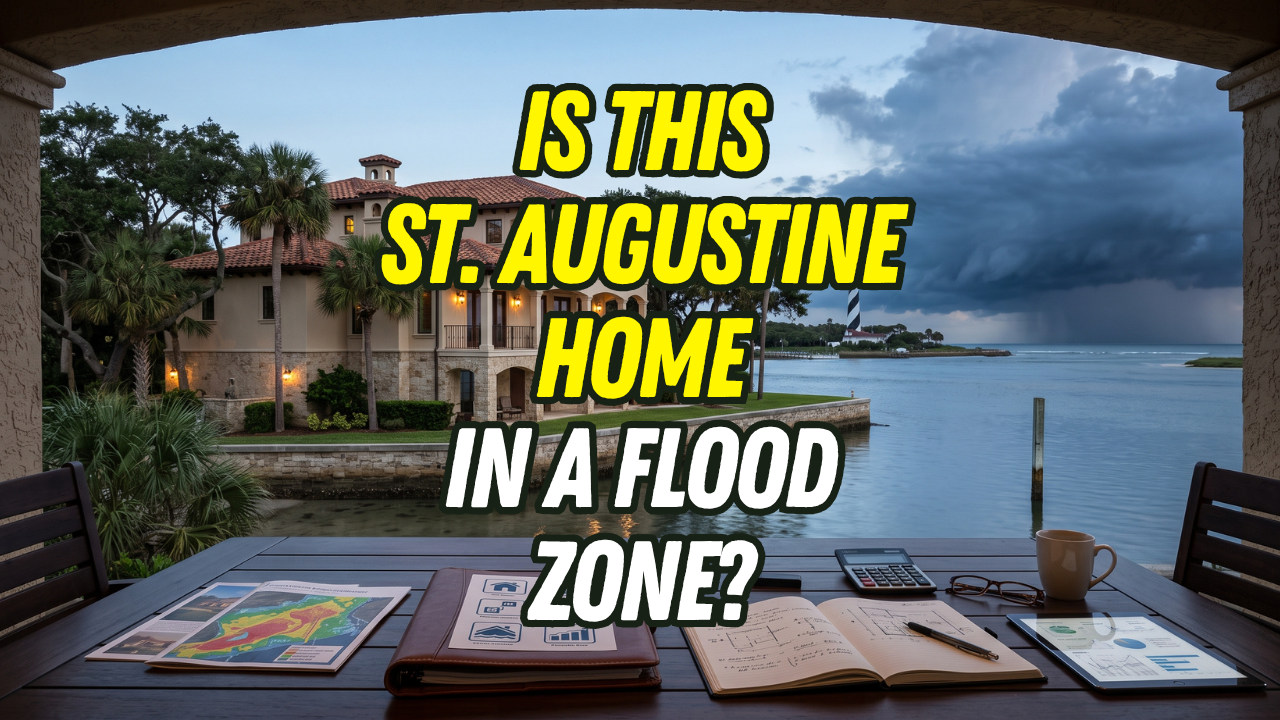
- Check the exact address on FEMA's current Flood Insurance Rate Map. Do not rely solely on a listing description or an old flood-zone screenshot.
- Know whether the structure is in a Special Flood Hazard Area. FEMA zones such as AE and VE are generally considered higher-risk Special Flood Hazard Areas.
- Ask for available elevation information. An elevation certificate can provide important property-specific information for some homes.
- Obtain insurance quotes before your financing and inspection periods expire. A lender's flood-insurance requirement is only one part of the cost question.
- Review the seller's flood disclosure. Florida residential sellers must provide specific flood information at or before execution of the sales contract.
- Investigate actual flood history and drainage. A FEMA zone is important, but it is not the complete story of how a particular home or street may perform during severe weather.
Why Flood Zones Matter So Much in St. Augustine
St. Augustine's relationship with water is one of the reasons people love living here—and one of the reasons flood due diligence matters. The Atlantic Ocean, Matanzas Bay, the San Sebastian River, Salt Run, creeks, tidal areas, barrier islands, low elevations, heavy rainfall, and storm surge all contribute to the local flood picture. The City of St. Augustine identifies flooding as a significant local hazard and says approximately 90% of city residents live in a floodplain. Flooding is also not limited to hurricanes. The city notes that flooding can result from ordinary rain coinciding with high tides, heavy local rainfall, storm surge, coastal storms, tropical systems, and overflowing rivers, creeks, or streams. That matters to buyers because a home does not have to sit directly on the ocean to warrant flood research. A property near a creek, marsh, bay, drainage area, or low-lying street may present a different risk profile than another home only a few blocks away. The practical takeaway is simple: evaluate flood risk by address and structure, not by neighborhood reputation alone.
What Do FEMA Flood Zones AE, VE, and X Mean?
FEMA Flood Insurance Rate Maps divide areas into flood-hazard zones. These designations help communities manage floodplain development and help lenders and insurers evaluate flood-related requirements.
Flood Zone AE
Zone AE is within FEMA's Special Flood Hazard Area, commonly abbreviated as SFHA. The SFHA represents land with at least a 1% chance of flooding in any given year under FEMA's mapped base-flood standard. That is why you will sometimes hear the outdated phrase “100-year floodplain.” The phrase can be misleading. It does not mean a flood happens only once every 100 years. A property can experience multiple qualifying flood events within a relatively short period. Zone AE generally includes a published Base Flood Elevation. That elevation can become important when evaluating the home's finished-floor elevation, construction requirements, mitigation, and insurance.
Flood Zone VE
Zone VE is also within the Special Flood Hazard Area, but it identifies a coastal high-hazard area where wave action is an additional concern. This designation is particularly important when evaluating coastal construction.
Depending on the property, buyers may need to pay closer attention to:
- Building elevation
- Foundation design
- Open areas below elevated structures
- Obstructions beneath the home
- Wind and flood insurance
- Storm-surge exposure
- Coastal erosion
A VE designation does not automatically mean you should reject a property. It means you should understand what you are buying and obtain qualified professional guidance before closing.
Flood Zone X
Zone X generally indicates an area outside FEMA's mapped Special Flood Hazard Area. This often means federally mandated flood insurance does not apply in the same way it generally does to financed buildings inside an SFHA. But there is an important distinction: Zone X does not mean “no flood risk.” FEMA maps are designed around specific flood-hazard standards. They do not guarantee that a property outside the SFHA cannot flood. Heavy rainfall, drainage problems, unusual tides, storm surge, overwhelmed infrastructure, and changing conditions can still cause water damage. That is why buyers should avoid treating the letter X as an automatic reason to skip flood insurance research.
What Is the Base Flood Elevation?
The Base Flood Elevation, often shortened to BFE, represents the calculated elevation floodwater is expected to reach during FEMA's base-flood event.
For buyers, the important comparison may be between that elevation and the elevation of the home's lowest relevant floor or other structural measurements.
A home's relationship to the BFE can affect:
- Flood vulnerability
- Construction requirements
- Floodplain compliance
- Potential mitigation options
- Insurance considerations
Do not try to interpret complex elevation data solely from a listing or a casual visual inspection.
When elevation is material to your purchase, request the available documents and consult the appropriate surveyor, engineer, insurance professional, floodplain official, or other qualified expert.
What Is an Elevation Certificate?
An Elevation Certificate is a standardized document that records elevation information about a building.
Depending on the home and circumstances, it may contain information about the building configuration, flood zone, Base Flood Elevation, and measured building elevations.
The City of St. Augustine provides a public portal where property information and available documents such as elevation certificates may be accessible.
The city also states that its Planning and Building Department can provide available elevation certificates for qualifying properties and information such as Base Flood Elevations and whether a property lies within an SFHA.
If an elevation certificate exists, review it early.
If one does not exist and elevation information is important to your decision, ask an appropriate professional whether obtaining one would be useful.
Will Your Lender Require Flood Insurance?
If a building is located in a FEMA Special Flood Hazard Area and the mortgage is federally backed, federal rules generally require flood insurance.
That is one reason AE and VE designations deserve immediate attention during a financed purchase.
Your lender will ultimately determine the flood-insurance requirements connected with your loan.
But buyers should not stop at the question, “Is insurance required?”
Ask instead:
- What coverage is required by the lender?
- What coverage does my insurance professional recommend?
- What is the annual premium?
- What deductible applies?
- What are the policy limits?
- What is excluded?
- Does the policy adequately reflect the home's replacement and contents risks?
A lender's minimum requirement is a financing requirement—not necessarily a complete personal risk-management strategy.
Standard Homeowners Insurance Generally Does Not Cover Flooding
One of the most important points for Florida buyers is that ordinary homeowners coverage and flood coverage are different things.
Florida's statutory flood-disclosure language explicitly warns buyers that homeowners insurance policies do not include coverage for damage resulting from floods and encourages buyers to discuss separate flood insurance with an insurance agent.
That distinction is particularly important if you are moving from an area where flood risk was never part of your previous homeownership experience.
Do not wait until the final days before closing to understand the insurance picture.
Get property-specific quotes early enough that the cost can influence your decision.
Florida Sellers Must Provide a Flood Disclosure
Florida law requires sellers of residential real property to provide a specified flood disclosure to the buyer at or before the time the sales contract is executed.
The current disclosure addresses whether the seller:
- Has knowledge of flooding that damaged the property during the seller's ownership
- Filed an insurance claim relating to flood damage
- Received assistance for flood damage, including FEMA assistance
This disclosure is useful, but it should not be treated as your entire flood investigation. A seller may have owned the property for only a limited period. A property may have flooded before that ownership. Conditions can change. Drainage improvements or surrounding development can alter circumstances. And a home that has never flooded before is not guaranteed to remain flood-free. Use the disclosure as one piece of the due-diligence file.
Historical Flooding Can Matter as Much as the Map
St. Augustine has experienced flooding from both tropical systems and heavy rainfall. The City of St. Augustine documents significant local flood events, including flooding associated with Tropical Storm Fay, Hurricane Matthew, and Hurricane Irma. Matthew caused flooding in areas including Davis Shores, Lincolnville, Historic Districts, and portions of Abbott Tract. Irma subsequently flooded many of the same areas. This does not mean every property in those areas flooded or carries identical risk. It means historical information belongs in the conversation.
Before closing, consider asking:
- Has this structure ever taken on water?
- Has the garage or crawlspace flooded?
- Has water reached the lot but not entered the home?
- Does the street hold water during heavy rain?
- Have nearby roads become impassable?
- Have drainage improvements been completed?
- Were repairs properly permitted?
The City of St. Augustine says its Planning and Building Department can provide historical flooding information, information about possible future flooding and local drainage problems, and expected floodwater levels for areas of the community.
Do Not Rely on the Listing's Flood-Zone Field Alone
A listing may include a flood-zone designation, but your due diligence should go to the official source. FEMA's Flood Map Service Center is the federal government's official public source for National Flood Insurance Program flood-hazard information. Search the exact address and review the current effective map. Why? Because flood maps can change. FEMA updates maps through multiple processes, and map amendments or revisions can affect individual parcels or structures. A seller may also possess a Letter of Map Amendment or other FEMA determination that changes how the structure is treated for mapped flood-hazard purposes. If you encounter an unfamiliar map determination or conflicting information, ask the lender, insurance professional, surveyor, floodplain administrator, or other qualified expert to explain it before closing.
Common Misconceptions About St. Augustine Flood Zones
“Zone X means the home cannot flood.”
False. It means the property is outside FEMA's mapped Special Flood Hazard Area under the applicable map designation. Flooding can still occur.
“If my lender doesn't require flood insurance, I don't need to think about flooding.”
Not necessarily. Lender requirements and personal risk are different questions.
“If the seller says the home never flooded, I'm done researching.”
No. Seller disclosure is important, but you should still review maps, insurance, available elevation information, drainage, and local history.
“The entire neighborhood has the same flood risk.”
Flood conditions can change from parcel to parcel because of elevation, structure design, drainage, waterways, and other site-specific factors.
“A 100-year flood happens once every 100 years.”
No. The commonly used phrase refers to a statistical 1% annual chance, not a schedule.
“An elevated coastal house automatically has no flood concerns.”
Elevation can reduce certain structural risks, but buyers still need to evaluate the complete property, including access, lower enclosures, utilities, foundations, insurance, storm surge, and surrounding roads.
Important Considerations Before Closing
Use this practical checklist before completing a St. Augustine purchase:
- Search the exact address through FEMA's official Flood Map Service Center.
- Confirm whether the building itself lies inside an SFHA.
- Identify the FEMA zone designation.
- Determine the applicable Base Flood Elevation when relevant.
- Obtain and review any available elevation certificate.
- Review the seller's required Florida flood disclosure.
- Ask about prior water intrusion and drainage problems.
- Review available historical flooding information.
- Obtain homeowners insurance quotes.
- Obtain flood insurance quotes or discuss the need for coverage.
- Confirm the lender's flood-insurance requirements.
- Review roof age, wind mitigation, and storm-protection features.
- Look at how surrounding roads and access routes may be affected by flooding.
- Have qualified professionals interpret technical documents you do not understand.
Most importantly, complete these steps while you still have time to make an informed decision under your contract. A flood-zone surprise should not be something you discover at the closing table.
“Kim did a great job selling our home! Quick, and stress free. Anything I couldn’t do, she was there. Even offered to help me cut the grass! I would definitely recommend her! Thank you, we so appreciated your helpfulness and ease.” — April P.
FAQ
How do I find the flood zone for a St. Augustine property?
Search the exact address through FEMA's Flood Map Service Center, which is the official public source for NFIP flood-hazard information. If the property is within the City of St. Augustine, the city's Planning and Building Department can also provide flood-hazard information and may have an elevation certificate or other property-specific records available.
What does Flood Zone AE mean?
Zone AE is within FEMA's Special Flood Hazard Area and is subject to the 1%-annual-chance base flood. Base Flood Elevations are generally established in AE zones. A federally backed mortgage on a building located in an SFHA generally triggers mandatory flood-insurance requirements.
What does Flood Zone VE mean?
Zone VE is a coastal high-hazard Special Flood Hazard Area where wave action is an additional hazard. Buyers considering a VE-zone property should carefully evaluate structure elevation, coastal construction, insurance, foundation design, and storm-related exposure with qualified professionals.
Is Flood Zone X safe from flooding?
No flood zone should be interpreted as a guarantee of zero risk. Zone X is generally outside FEMA's mapped Special Flood Hazard Area, but rainfall, drainage problems, storm surge, tides, and other conditions can still produce flooding. Buyers should evaluate the actual property and consider discussing optional flood insurance with an insurance professional.
Can a home's FEMA flood-zone designation change?
Yes. FEMA flood maps can be updated, and formal map-change determinations such as Letters of Map Amendment or map revisions can affect individual properties. Always review current effective information rather than relying on an old map or prior transaction.
Know the Flood Risk Before You Own It
Buying a home in a flood zone is not automatically a reason to walk away from a St. Augustine property.
Buying without understanding the flood risk is the bigger problem.
Two homes in the same general area can have very different elevations, construction, insurance costs, drainage characteristics, and historical experiences with water.
By checking the map, reviewing elevation information, obtaining insurance quotes, examining disclosures, and asking property-specific questions before closing, you can make the decision with much better information.
Next Steps
If you are buying in St. Augustine and flood-zone information is part of your decision, the Kim Devlin Team can help you organize the real estate side of that due diligence before closing. That can include helping you identify which property-specific questions need answers, locating available transaction documents, coordinating with the seller and other parties, and helping you connect the information from FEMA maps, local records, inspections, lenders, and insurance professionals to the home you are considering. Contact the Kim Devlin Team before you close on a St. Augustine property so you can evaluate the home with a clearer understanding of its location, flood-zone considerations, ownership costs, and the questions that still need to be answered.
The Kim Devlin Team provides real estate guidance and does not determine flood zones, engineering risk, insurance coverage, legal obligations, or future flooding. Flood maps, laws, insurance requirements, premiums, elevations, and property conditions can change. Buyers should verify material information with FEMA, the applicable local government, their lender, licensed insurance professionals, surveyors, engineers, inspectors, attorneys, and other qualified professionals as appropriate.
Check out this article next