

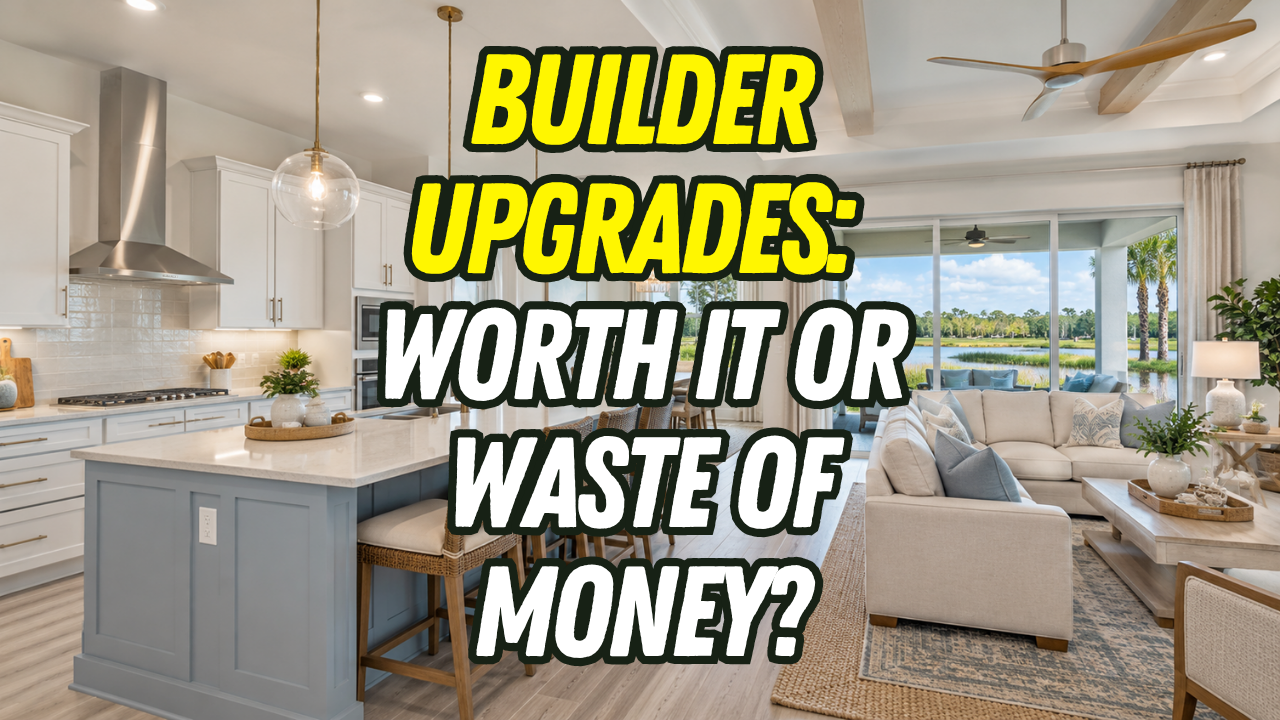
The builder upgrades most worth paying for in St. Augustine are usually structural changes, useful electrical and plumbing additions, appropriate storm protection, and durable materials suited to Florida's climate. Expanded living areas, covered lanais, and practical storage can also be worthwhile. Decorative upgrades such as premium light fixtures, cabinet hardware, and elaborate backsplashes are often easier to add later and may not justify builder pricing.
- Structural upgrades: Additional usable space, expanded lanais, and layout changes that are difficult to make later.
- Storm protection: Code-compliant impact-resistant windows, doors, or other appropriate protection systems when the benefits justify the upgrade.
- Electrical and plumbing: Extra outlets, EV charging readiness, dedicated circuits, and plumbing rough-ins installed before walls are finished.
- Energy efficiency: Insulation, appropriately sized HVAC systems, and window improvements with measurable benefits.
- Durable flooring: Moisture-resistant, easy-to-maintain surfaces appropriate for everyday Florida living.
- Outdoor functionality: Covered patios, practical lanai extensions, and preparations for future outdoor improvements.
The most important distinction is not whether an upgrade looks impressive in the builder's model home. It is whether the improvement solves a meaningful problem, fits your budget, and would be costly or disruptive to install after closing.
1. Which Structural Upgrades Should You Prioritize?
Structural upgrades deserve attention because they may be difficult, disruptive, or financially impractical to add after the home is finished.
When buying a new-construction home in St. Augustine or surrounding St. Johns County communities, consider how you will use the property five or ten years from now. A floor plan that works today may feel restrictive as your household, work arrangements, or lifestyle changes.
Depending on the builder and construction stage, worthwhile structural options may include:
- Extending a covered lanai to create more usable outdoor living space.
- Expanding a garage for storage, bicycles, recreational equipment, or larger vehicles.
- Adding a bedroom, flex room, or home office where the floor plan permits.
- Choosing a larger shower or more functional bathroom layout.
- Adding useful windows or doors where the structural design and applicable requirements allow.
For example, suppose you are deciding between a larger covered patio and an expensive decorative kitchen package. If you expect to use the patio regularly, and expanding it later would require significant demolition, permits, and construction, the patio may provide more practical long-term value.
That does not mean every structural upgrade is a good investment. An expensive room addition that pushes the home's price far above comparable properties in the community deserves closer examination.
The better question is: Would I still want this feature if I never recovered its full cost when selling?
If the answer is yes, the upgrade may be justified by its everyday usefulness. If resale is the main reason, compare nearby properties before committing.
2. Are Hurricane Protection and Energy-Efficiency Upgrades Worth It?
Florida's climate makes this category especially important, but buyers should avoid paying twice for protection or efficiency features already included in a builder's standard specifications.
Impact-Resistant Windows and Doors
Before purchasing an impact-window upgrade, request the builder's standard window specifications and information about any required windborne-debris protection.
St. Johns County's wind design requirements depend on the project's location and applicable building code. Some homes may already include protection solutions designed to satisfy the relevant requirements.
Impact-resistant windows can offer convenience compared with installing removable storm shutters, but that convenience has a price. Ask whether the upgrade offers benefits beyond the standard protection package.
Review these details:
- What window and door protection is included in the base price?
- Does the upgrade cover all relevant openings or only certain windows?
- What product approvals and performance ratings apply?
- What documentation will be available for insurance review?
- How much would a comparable protection solution cost outside the builder package?
Do not assume impact-resistant windows automatically produce a specific insurance discount. Eligibility and pricing depend on the insurer, the home's characteristics, and documented mitigation features.
Insulation, HVAC, and Efficient Windows
Air-conditioning performance matters in Northeast Florida, where warm and humid conditions can make indoor comfort a year-round consideration.
Potentially worthwhile upgrades include better attic insulation, improved air sealing, energy-efficient windows, and an appropriately designed HVAC system.
However, a higher-priced air-conditioning package is not automatically better. System sizing, duct design, humidity control, installation quality, and the home's overall efficiency can matter as much as the equipment's advertised efficiency rating.
Ask the builder for written specifications and projected performance differences. Compare those benefits against the actual upgrade price rather than assuming that every premium efficiency package pays for itself.
3. Should You Upgrade Flooring, Kitchens, and Bathrooms?
This is where many new-construction budgets become stretched. Kitchens and bathrooms attract attention, and model homes are designed to showcase premium finishes. But expensive finishes do not necessarily produce equivalent resale value.
Flooring: Favor Durability and Function
St. Augustine homeowners often deal with humidity, sand, wet shoes, pets, and frequent transitions between indoor and outdoor spaces.
For many households, porcelain tile and suitable luxury vinyl plank products are worth considering because they can offer practical maintenance advantages when properly selected and installed.
Compare flooring based on:
- Resistance to everyday moisture and wear.
- Cleaning and maintenance requirements.
- Manufacturer warranty and installation standards.
- Comfort, appearance, and suitability for the intended rooms.
- Builder pricing versus the cost and disruption of replacement later.
Upgrading flooring during construction may prevent the inconvenience of tearing out brand-new floors shortly after closing. But if the builder's premium flooring package is unusually expensive, obtaining independent estimates can help you decide whether waiting makes sense.
Kitchens: Prioritize Function Before Decorative Details
Kitchen upgrades can make daily living more comfortable, particularly when they improve storage, workspace, or the overall layout.
Cabinet configuration, additional drawers, useful pantry storage, and a functional island may offer greater everyday value than a dramatic backsplash or decorative cabinet pulls.
Countertop upgrades should be evaluated on durability, maintenance, appearance, and price. A premium stone selection is not automatically the best value simply because it has a higher price tag.
Lighting fixtures, cabinet hardware, and many backsplash materials can often be changed after closing without major structural work.
Bathrooms: Spend on Layout and Lasting Function
Bathroom improvements are worth considering when they are difficult to retrofit, such as expanding a shower, changing plumbing locations, or modifying the room's configuration.
Decorative mirrors, towel bars, faucets, and certain light fixtures are generally simpler improvements to revisit later.
Rather than selecting the most expensive package, think about what will make the space easier to use, clean, and maintain over time.
4. Which Electrical, Plumbing, and Outdoor Upgrades Should You Consider?
Some of the most useful builder upgrades are features you will barely notice during a model-home tour.
Electrical and plumbing choices can be especially valuable because installation is often easier before drywall, flooring, and other finishes are completed.
Depending on the property and your plans, consider:
- EV charging readiness: An appropriately designed circuit, conduit, or panel capacity for a future electric vehicle charger.
- Additional outlets: Convenient locations for home offices, garages, kitchens, and outdoor spaces.
- Ceiling fan preparation: Properly rated boxes and wiring in rooms or covered outdoor areas.
- Network wiring: Data connections for home offices or entertainment spaces.
- Outdoor plumbing: Approved rough-ins for a future outdoor kitchen or other planned improvements.
- Garage utility: Electrical capacity and practical storage-related improvements.
Suppose you plan to install an outdoor kitchen in two years. Having properly located utilities installed while the home is under construction may reduce future disruption.
But do not pay for infrastructure you are unlikely to use. A pool pre-plumb, outdoor kitchen connection, or EV circuit only makes sense when it matches a realistic future plan.
Outdoor Living in Northeast Florida
Covered outdoor space can be attractive in St. Augustine, particularly for buyers who enjoy entertaining, relaxing outdoors, or using a screened lanai.
Before purchasing a patio extension, screen enclosure, or pool-related option, review the lot's dimensions, drainage conditions, easements, setbacks, and community restrictions.
Also verify whether the upgrade is included in the construction contract or would require separate approvals and work after closing.
Coastal exposure and flood risk deserve attention when appropriate. A property's flood-zone designation and elevation can affect construction requirements, design choices, and insurance considerations.
An expensive outdoor upgrade that cannot be implemented as planned because of site restrictions is not a bargain at any price.
5. How Do You Decide Whether a Builder Upgrade Is Actually Worth the Cost?
Before signing a design center selection sheet, evaluate each upgrade against three questions: Is it difficult to install later? Will you use it regularly? Does its price make sense compared with comparable homes and alternative contractors?
Use the following decision framework:
| Upgrade | General Priority | Why |
|---|---|---|
| Structural layout changes | High | Often difficult and disruptive to change later |
| Useful electrical and plumbing rough-ins | High | May be easier to install before walls are finished |
| Appropriate storm protection | High when needed | Safety, convenience, and possible insurance considerations |
| Insulation and HVAC improvements | Evaluate closely | Potential comfort and operating-cost benefits |
| Durable flooring | Medium to high | Daily use and possible replacement disruption |
| Premium countertop materials | Personal preference | Appearance and maintenance matter more than price alone |
| Decorative lighting and hardware | Often lower | Frequently practical to replace later |
| Elaborate backsplash packages | Often lower | Generally cosmetic and potentially easier to add later |
These are general priorities, not promises of financial return. A feature that is useful in one St. Augustine community may have limited appeal in another.
Compare the Full Purchase Price, Not Just the Upgrade Cost
Builders may present upgrades as relatively small additions to a monthly mortgage payment. That framing can make expensive selections feel more affordable than they are.
Consider a hypothetical $15,000 upgrade financed over 30 years at 6.5% interest. If the full amount is financed, it adds approximately $95 per month in principal and interest, or roughly $19,100 in interest over 30 years if the loan is held for the full term.
This is only an illustration, not a current mortgage quote. Your actual costs will depend on your financing terms, down payment, taxes, insurance, and the lender's approval.
Also ask how builder incentives apply. A closing-cost credit, design center allowance, or interest-rate incentive may come with conditions. Compare the complete purchase package rather than treating incentives as automatically free value.
Finally, remember that an appraisal may not support every dollar spent on upgrades. Lenders and appraisers evaluate the home in relation to relevant comparable properties, not simply the amount on your builder's selection sheet.
Common Misconceptions About Builder Upgrades
Every upgrade increases resale value.
Upgrades can improve a property's usefulness and appeal, but they do not guarantee a dollar-for-dollar increase in market value. Comparable sales, condition, location, and buyer preferences still matter.
Builder upgrades are always more expensive than hiring your own contractor.
Not necessarily. Some builder options are competitively priced, and installation during construction may avoid later demolition or duplicate labor. Compare written estimates and account for warranty and scheduling differences.
You should select every upgrade before closing.
Many cosmetic changes can wait. Keeping money available for moving expenses, furnishings, landscaping, maintenance, and unexpected costs may be more valuable than maximizing the design center budget.
A model home's features are standard.
Model homes can include optional finishes, structural modifications, and decorative packages. Request an itemized list showing what is standard and what costs extra.
Important Considerations Before Finalizing Your Builder Selections
Builder upgrade pricing is only one part of a new-construction purchase. Before making final selections, review the construction contract, option deadlines, financing terms, and any requirements for buyer deposits.
- Get everything in writing. Confirm product descriptions, specifications, prices, and installation responsibilities.
- Review option deadlines. Some changes become unavailable once plans are approved or construction reaches a particular stage.
- Check warranty coverage. Understand how builder-installed upgrades and later contractor-installed improvements may affect applicable warranties.
- Compare neighborhood values. Avoid assuming an extensively upgraded home will command a proportionally higher resale price.
- Understand flood and site conditions. Review the property-specific flood information, drainage, and applicable restrictions.
- Consider independent inspections. Ask about appropriate inspection opportunities during construction and before closing.
- Review representation early. Builder sales representatives work for the builder. Understand your buyer-representation options before registering or signing documents.
For buyers comparing different communities, the best decision may involve the total cost of ownership rather than one specific upgrade package.
A home with fewer designer finishes but a better lot, more functional floor plan, or location that supports your lifestyle may ultimately be the stronger choice.
Frequently Asked Questions About Builder Upgrades
Are builder upgrades cheaper during construction or after closing?
Structural modifications, electrical wiring, plumbing rough-ins, and layout changes are often more practical during construction. Cosmetic upgrades may cost less through independent contractors after closing, depending on the builder's pricing and the work involved. Compare itemized quotes before deciding.
Do builder upgrades increase home resale value in St. Augustine?
Some upgrades improve resale appeal, especially functional layouts, storm protection, and durable finishes. But there is no guaranteed dollar-for-dollar return. Comparable sales, neighborhood expectations, buyer preferences, and market conditions all influence resale value.
Are impact-resistant windows worth upgrading in St. Augustine?
They can be worthwhile when they provide meaningful storm protection, convenience, or other documented benefits beyond the builder's standard package. First verify local code requirements, included protection, product specifications, pricing, and potential insurance considerations.
Can builder upgrades be included in a mortgage?
Many builder-contracted upgrades can be incorporated into the purchase price and financed when the lender permits and the property appraises adequately. Financing increases the amount borrowed and potentially the total interest paid. Confirm the details with your lender before approving selections.