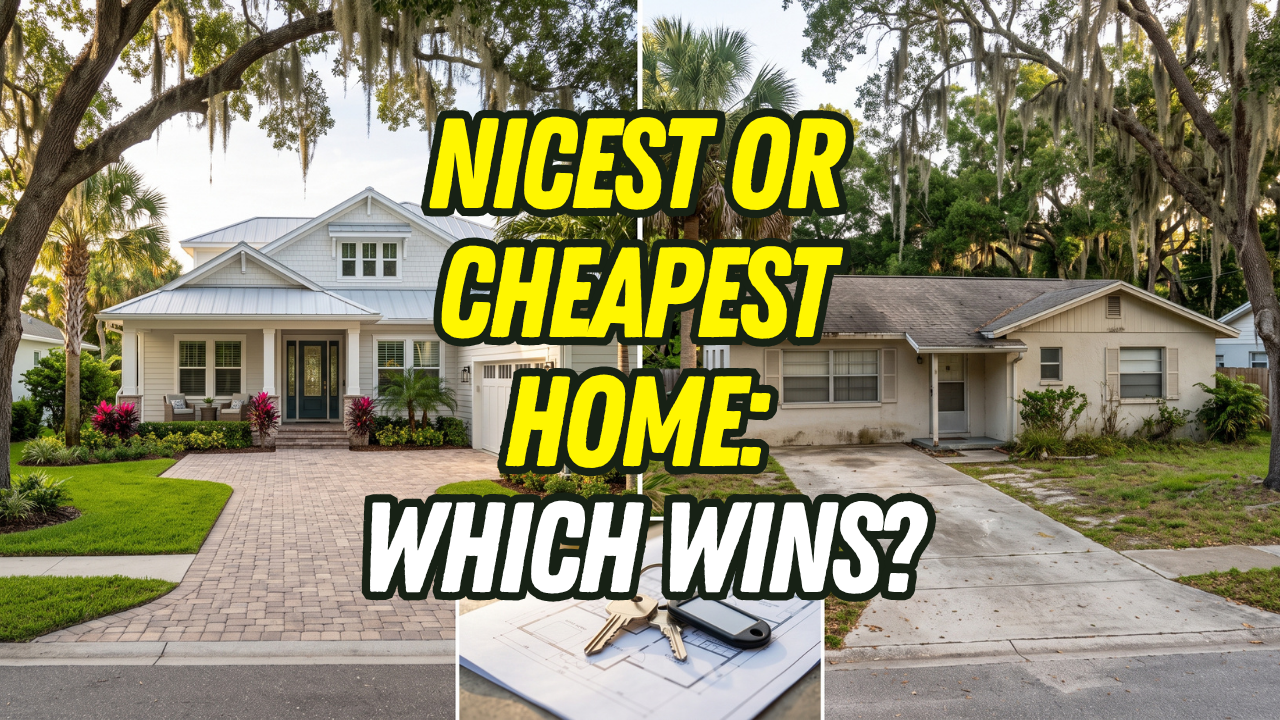
Neither the nicest house nor the cheapest house is automatically the best purchase in St. Augustine, Florida.
The smarter choice is the property that offers the best combination of purchase price, condition, ownership costs, and future resale potential. A cheaper home may offer an opportunity to build equity through improvements, while a more expensive home may justify its price with desirable features, better condition, and fewer immediate expenses.
- The cheapest house can offer value when repairs are manageable and the total investment remains competitive with neighborhood sales.
- The nicest house may be worth the premium when improvements, condition, lot characteristics, and location support its price.
- Neither extreme guarantees appreciation. Future value depends on market conditions, property characteristics, and buyer demand.
- Consider total ownership costs. Insurance, taxes, repairs, maintenance, HOA fees, and flood exposure can change the financial comparison.
- A home priced between the extremes may offer the strongest balance of affordability, condition, and resale flexibility.
Why Buying the Cheapest House in a Neighborhood Can Make Sense
The idea of purchasing the cheapest house in a desirable neighborhood has been popular for years. The reasoning is straightforward: if nearby homes sell for substantially more, buying a property at a lower price may create an opportunity to make improvements while keeping your overall investment within the neighborhood's established price range.
But there is an important distinction between purchasing an inexpensive home and purchasing a good value.
Imagine two hypothetical homes in a St. Augustine community. One is listed for $385,000 and needs a roof replacement, new flooring, and kitchen updates. Another is listed for $445,000 and has already received substantial improvements.
The first property costs $60,000 less, but that does not automatically make it the better purchase. If the repairs and renovations cost more than the difference in price, you could end up spending more for a property that still has fewer desirable features.
The cheapest house becomes attractive when the improvements are financially manageable, the property's underlying condition is sound, and comparable sales support the total amount you plan to invest.
For example, cosmetic updates such as paint, fixtures, landscaping, and flooring may be more predictable than correcting structural problems, replacing major systems, or resolving extensive moisture damage.
In St. Augustine and surrounding communities, construction age, property location, and building condition can vary considerably. A lower-priced older home near Historic Downtown presents different considerations from a newer property in a planned community.
The real question is not how much less the house costs today. It is how much you will have invested when the property meets your needs.
When Buying the Nicest House in the Neighborhood Makes Sense
The nicest house in a neighborhood often has advantages that are difficult to overlook. It may offer updated kitchens, renovated bathrooms, modern systems, attractive landscaping, superior outdoor living spaces, and a layout that works without major changes.
For a homebuyer who wants to move in without handling extensive renovation projects, those benefits can justify a higher purchase price.
However, there is a financial consideration. If the home is significantly more expensive than surrounding properties, its value may be harder to support with comparable sales.
That does not automatically mean the property is overpriced. A larger lot, better location within the community, superior construction, or unusual architectural features may support a premium.
The challenge comes when the higher price is based primarily on improvements that future buyers may not value as highly.
An expensive kitchen renovation, for example, does not guarantee an equivalent increase in resale value. Some improvements make a property more enjoyable without returning their entire cost when the home is sold.
Consider how long you expect to own the property. If you plan to stay for many years, the convenience of purchasing a finished home may be important. If you expect to relocate sooner, paying a substantial premium above neighborhood comparable sales deserves closer examination.
The nicest house can be the right purchase when its price is supported by market evidence, its features meet your priorities, and the cost of ownership fits comfortably within your budget.
What Makes This Decision Different in St. Augustine, Florida?
St. Augustine and its surrounding communities offer a wide range of housing options, from older homes near the historic district to coastal properties, established subdivisions, and newer communities throughout St. Johns County.
Because these properties can have very different ownership costs, comparing purchase prices alone can be misleading.
Flood Exposure and Property Insurance
Flood exposure is an important consideration when evaluating homes in the St. Augustine area.
Two properties with similar asking prices may have different flood-related risks and insurance requirements.
A lower-priced home may become more expensive to own if additional flood coverage or mitigation work is needed.
Buyers should review the specific property's flood information, evaluate any known history of water intrusion, and obtain appropriate insurance quotes before purchasing.
You can research mapped flood hazards through the
FEMA Flood Map Service Center.
Flood risk can exist outside high-risk mapped flood zones.
Roof Condition and Wind Mitigation
Florida homeowners insurance costs can be influenced by property characteristics, including roof condition, age, and documented wind-mitigation features.
An older roof may create expenses that are not obvious from the listing price.
A more expensive home with a recently installed roof and documented improvements may offer practical advantages, although actual insurance eligibility and premiums must be verified.
Before committing to a purchase, obtain insurance quotes based on the specific property's characteristics.
Property Taxes, HOA Fees, and CDD Assessments
Homebuyers should also consider property taxes and community-related expenses.
The seller's existing property tax bill may not reflect what a new buyer will pay after ownership changes.
Some communities also have homeowners association fees or Community Development District assessments that increase ongoing ownership costs.
Review these expenses and investigate applicable homestead exemptions through the
St. Johns County Property Appraiser.
Renovation Costs and Permitting
Renovating an older property may require permits, inspections, and compliance with current building requirements.
Certain properties may also be subject to historic-preservation restrictions or community architectural guidelines.
Before purchasing a lower-priced home with renovation plans, confirm that the improvements you want are permitted and financially practical.
These local considerations reinforce why the purchase price alone does not determine which home is the better value.
"Kim Devlin was so easy to work with and extremely knowledgeable. She kept everything on track for a tight purchase and close time frame."— Marya M.
Common Misconceptions About Buying the Best or Cheapest House
Misconception 1: The cheapest house always has the greatest appreciation potential.
A low purchase price does not guarantee future appreciation. Expensive repairs, undesirable property characteristics, or a weakening market can reduce the financial advantage.
Misconception 2: The nicest house is always a bad investment.
An exceptional property may justify its higher price through location, land, construction, and features that remain valuable over time. Comparable sales help determine whether the premium is reasonable.
Misconception 3: Renovations automatically increase value by their full cost.
Renovation expenses and market value are not the same. Buyers may not pay dollar-for-dollar for improvements completed by a previous owner.
Misconception 4: Asking prices establish neighborhood value.
Active listings show what sellers are requesting. Recently closed comparable sales provide stronger evidence of what buyers have actually paid.
Important Considerations Before Making Your Offer
Before deciding between the highest-priced and lowest-priced properties in a neighborhood, evaluate the options using the same criteria.
- Review comparable sales.
Focus on recent transactions involving homes with similar location, condition, size, and amenities. - Evaluate the physical condition.
Arrange appropriate inspections and investigate any significant issues. - Estimate improvement expenses.
Obtain reliable contractor estimates and account for potential unexpected costs. - Calculate ongoing ownership costs.
Review insurance, taxes, community assessments, utilities, and maintenance. - Consider future resale.
Ask whether the purchase price is supported by market evidence and how the property may compare with future competition. - Match the property to your plans.
Your renovation tolerance, financial reserves, desired lifestyle, and expected ownership period should influence the decision.
Nicest House vs. Cheapest House: Side-by-Side Comparison
| Consideration | Cheapest House | Nicest House |
|---|---|---|
| Initial purchase price | Typically lower | Typically higher |
| Renovation needs | May require substantial work | May need fewer immediate updates |
| Ownership costs | Depend on property condition and location | Depend on property condition and location |
| Resale considerations | Improvements must be supported by market value | Purchase premium must be supported by comparable sales |
| Best suited for | Buyers comfortable with repairs and improvements | Buyers prioritizing finished features and convenience |
There is also a third option worth considering: a well-maintained home priced near the middle of its comparable market.
For many buyers, a property that needs relatively little work and is supported by recent neighborhood sales can offer a sensible balance between cost and convenience.
"I have lived around the country and experienced many realtors. Kim Devlin will make your search fun, her expertise and experience is top-tier, the top 1% for sure. If she can not find it, it's not out there... Thank you Kim for all your research and time spent with us."— Brian R.
Frequently Asked Questions
Is buying the cheapest house in a neighborhood a good investment?
It can be, provided the purchase price, repair costs, and likely resale value make financial sense. A low asking price alone does not make a home a good investment.
Is buying the most expensive house in a neighborhood a mistake?
Not necessarily. A premium may be justified by location, lot size, construction quality, condition, or features. However, buyers should review comparable sales to determine whether the price is supported.
What should St. Augustine homebuyers consider before purchasing?
Buyers should evaluate comparable sales, home condition, renovation expenses, insurance costs, flood exposure, property taxes, HOA or CDD fees, and potential resale value.
Is buying a midpriced home sometimes the smartest choice?
Yes. A well-maintained home priced near comparable neighborhood sales may provide a practical balance of condition, affordability, and resale flexibility.
Next Steps: Find the Right Home, Not Just the Right Price
When choosing between the nicest house and the cheapest house in a St. Augustine neighborhood, the goal should not be to purchase at either extreme.
The goal is to understand what each property offers, what it will cost to own, and how its price compares with similar homes.
If you are comparing properties in St. Augustine or the surrounding communities, the Kim Devlin team can help you evaluate the options.
From reviewing neighborhood comparable sales to discussing property condition, potential improvements, and resale considerations, the team can help you identify the questions that matter before making an offer.
Contact the Kim Devlin team to discuss the homes you are considering and develop a purchase strategy based on your needs, budget, and long-term goals.
Check out this article next