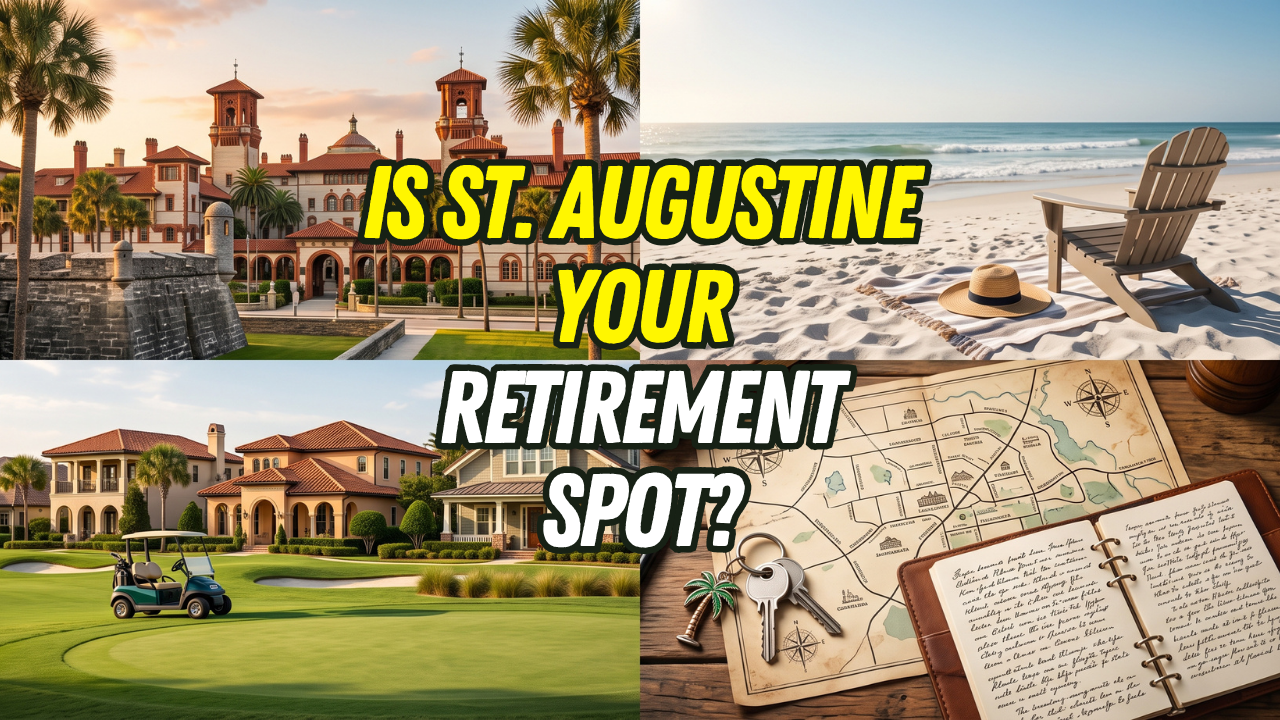
3. St. Augustine offers culture and history that go well beyond a typical beach town.
4. Buyers can choose from very different housing and community styles.
5. Healthcare services are available locally, with additional options throughout Northeast Florida.
6. The area's size gives you access to amenities without requiring a major-city lifestyle.
7. Retirement here can be as active—or as relaxed—as you choose.
Those seven reasons explain the appeal, but your final decision should come down to something more personal: whether St. Augustine fits the way you want your retirement years to work day to day.
1. Florida Has No Personal State Income Tax
Taxes are not the only reason to choose a retirement destination, but they can affect how far your retirement income goes. Florida does not impose a personal state income tax. For someone moving from a state that does tax individual income, that can materially change the household budget. That does not mean retirement in Florida is tax-free.
You still need to account for:
- Federal income taxes
- Property taxes
- Sales taxes
- Homeowners insurance
- Flood insurance where appropriate
- HOA or CDD fees
- Vehicle and household expenses
Do not compare retirement destinations based on one tax alone. Look at your complete financial picture.
For homeowners, it is also important not to assume that the property-tax bill shown on a listing will automatically become your future tax bill. The seller's assessed value, exemptions, and ownership history may differ from yours.
2. Beaches and Outdoor Recreation Can Become Part of Everyday Life
One of St. Augustine's biggest retirement advantages is that outdoor recreation does not have to be reserved for vacations.
Depending on where you live, you can build regular routines around:
- Walking the beach
- Swimming
- Fishing
- Kayaking
- Paddleboarding
- Boating
- Surfing
- Biking
- Golf
- Walking trails
- Birding and wildlife observation
Anastasia State Park is one of the area's most important natural assets, combining Atlantic beach, dunes, maritime habitat, paddling, trails, and other recreational opportunities close to the city. The larger St. Augustine area also gives you several distinct coastal environments rather than one single beach. St. Augustine Beach offers convenient access to restaurants and beach-town activity. Vilano Beach provides a different coastal setting north of downtown. Crescent Beach creates another option farther south on Anastasia Island. The retirement question is not simply, “Do I like the beach?”
Ask how often you realistically want to use it. You may discover that living five or ten minutes away gives you the lifestyle you want without paying for a property directly beside the ocean.
3. St. Augustine Has More Culture Than the Typical Beach Town
If you want retirement to include more than sunshine and golf, St. Augustine has an unusually deep cultural foundation. Founded in 1565, St. Augustine is the oldest continuously occupied settlement of European and African American origin in the United States. Its history includes Spanish colonial settlement, British rule, Fort Mose and the story of the first legally recognized free Black community in what became the United States, the Flagler era, and major events in the Civil Rights Movement. That history remains visible today through architecture, historic sites, museums, neighborhoods, streets, and public spaces.
Living here also gives you access to:
- Local restaurants
- Art galleries
- Museums
- Live music
- Seasonal festivals
- Historic attractions
- Community events
- Nearby performance venues
For a retiree who wants things to do without having to create an itinerary around a major metropolitan area, that can be a meaningful advantage. There is a tradeoff: visitors are drawn to those same attractions. Historic Downtown can become busy during holidays, festivals, weekends, and major events.
If you are considering living close to downtown, visit during both quiet and busy periods before deciding.
4. You Have Very Different Housing and Community Options
Retiring in St. Augustine does not mean choosing one particular type of community.
The larger area includes:
- Historic homes close to downtown
- Beach cottages
- Oceanfront and waterfront properties
- Condos
- Townhomes
- Golf communities
- Gated neighborhoods
- Established subdivisions
- New construction
- Master-planned communities
That variety matters because retirement housing needs are personal. You may want a one-story home with minimal stairs. Another buyer may prefer a condominium where exterior maintenance is handled by an association. Someone else may want golf outside the front door, while another buyer would rather be able to walk to restaurants or the beach.
Think beyond the purchase price. Your retirement-home comparison should include:
- Mortgage payment, if applicable
- Property taxes
- Homeowners insurance
- Flood insurance
- HOA fees
- CDD assessments
- Exterior maintenance
- Roof and major-system reserves
- Landscaping
- Club or golf fees
U.S. Census Bureau estimates for 2020–2024 put the median value of owner-occupied housing within St. Augustine city proper at $439,800 and median monthly owner costs for households with a mortgage at $1,966. Those figures are useful context, but they are historical Census estimates—not today's listing prices—and they cover St. Augustine city proper rather than every property marketed with a St. Augustine address. For retirement planning, individual-property numbers matter far more than a citywide median.
5. Healthcare Services Are Available Locally
Healthcare becomes increasingly important when choosing where to spend your retirement years. St. Augustine has local primary, specialty, urgent, and hospital-based healthcare services, while the broader Northeast Florida region expands the range of medical options available to residents. Before choosing a neighborhood, however, think beyond whether a hospital exists somewhere in the area.
Ask:
- How far am I from my preferred primary-care provider?
- Where are the specialists I am likely to use?
- How long does the drive take at normal traffic times?
- What facilities participate in my health plan?
- Will stairs or home design become an issue later?
- Could I remain in this home if my mobility changes?
A beautiful home 30 minutes from the services you use every week may be a weaker retirement fit than a less dramatic property located near everything you need. Your healthcare needs are personal, so verify provider availability, insurance participation, and specialty access before moving.
6. St. Augustine Offers a Smaller-City Lifestyle Within Northeast Florida
St. Augustine can appeal to people who want activity and services without living in the middle of a large city. The U.S. Census Bureau estimated St. Augustine city's population at 16,141 in 2025. That number covers the incorporated city itself, not the much larger collection of communities that use St. Augustine mailing addresses.
That relatively compact historic core creates part of the city's character. You can find restaurants, cultural attractions, waterfront areas, and historic streets concentrated into a relatively small area, while suburban, beach, and master-planned communities extend outward.
You also remain connected to the larger Northeast Florida region. For some retirees, that creates an appealing middle ground: St. Augustine does not need to feel like a major metropolitan city every day, but you are not isolated from the broader Jacksonville region.
Traffic deserves consideration, though. St. Augustine's own mobility planning acknowledges increased visitor activity, regional population growth, congestion, and parking pressure around the Historic District. If your retirement vision includes frequent trips downtown, to the beach, or north toward Jacksonville, test those routes at the times you would actually use them.
7. You Can Build an Active—or Relaxed—Retirement
Perhaps the strongest reason to consider St. Augustine is flexibility. Your retirement could revolve around golf and community amenities. It could revolve around walking to coffee shops and restaurants. It could center on the beach, boating, fishing, kayaking, gardening, volunteering, historic preservation, cultural events, or simply spending more time outdoors. Or it could combine several of those.
Census data also show that adults age 65 and older represent a meaningful share of the population within St. Augustine city proper. That does not mean any neighborhood should be selected because of the age of its residents. It does show that retirement-age residents already form a substantial part of the city's overall population. The more useful question is what you want your ordinary Tuesday to look like. Where will you walk? Where will you shop? How often will you use the beach? Do you want yard work or would you rather have maintenance handled? Do you want activity just outside your door, or do you value privacy? Your answers should drive the home search.
What Are the Tradeoffs of Retiring in St. Augustine?
A retirement guide should not discuss only the advantages. St. Augustine has practical issues buyers should evaluate before moving.
Insurance can materially affect housing costs. Obtain homeowners insurance quotes early instead of waiting until the end of the purchase process.
Flood exposure varies by property. Coastal and low-lying areas require careful investigation. The City of St. Augustine maintains flood-zone, elevation-certificate, and historical flood information that buyers can use as part of their due diligence.
Hurricanes are part of Florida coastal living. Consider roof age, wind mitigation, shutters or impact protection, drainage, insurance deductibles, and evacuation planning.
Tourism creates traffic. Historic Downtown and surrounding routes can be particularly busy during major events and peak visitor periods.
Heat and humidity are real lifestyle factors. Visit during summer before assuming that the climate will suit you year-round.
Housing costs vary widely. A beach condo, historic home, golf property, and suburban new-construction home can have dramatically different expense structures.
Important Questions to Ask Before Retiring in St. Augustine
- What is my realistic monthly retirement housing budget?
- Do I want downtown, beach, golf, suburban, or master-planned living?
- Do I want a single-story home?
- How much property maintenance am I willing to handle?
- What will homeowners insurance cost?
- Do I need or want flood insurance?
- Is the property located in a flood zone?
- What are the HOA or CDD fees?
- Are club memberships separate from HOA dues?
- How close are my doctors and healthcare facilities?
- How close do I want to be to the beach?
- How frequently will I travel to Jacksonville?
- Could the home still work for me if my mobility changes?
- What does the neighborhood feel like during tourist season?
Those questions will tell you far more about whether St. Augustine fits your retirement than a national “best places to retire” ranking ever could.
“We cannot say enough wonderful things about our realtor, Kim Devlin! She was truly incredible throughout our entire home-buying experience. This was our first time selling a home and buying another, and to make things even more challenging, we were selling our home in Maine while purchasing our new home in Florida.
From the very beginning, Kim made the entire process feel easy and manageable. Even while we were still in Maine, she went above and beyond to help us find the right home. She was incredibly knowledgeable about St. Augustine and the surrounding areas and took the time to really understand what we were looking for. She always seemed to know exactly where we needed to be and guided us every step of the way.
Thanks to Kim, we found a home and community that we absolutely love. Moving states is a huge life transition, but having someone as knowledgeable, responsive, trustworthy, and genuinely caring as Kim made such a difference.
We would highly recommend Kim Devlin to anyone looking to buy or sell a home in St. Augustine or the surrounding areas. If you're looking for a realtor who truly goes above and beyond and makes you feel like you're her only client, Kim is your girl! We are so grateful we found her!”— Allyson Cumming
FAQ
Is St. Augustine a good place to retire?
St. Augustine can be an attractive retirement destination if your priorities include coastal recreation, historic and cultural activities, Florida's tax structure, outdoor living, and a range of housing environments. Whether it is right for you depends on your budget, healthcare needs, maintenance preferences, insurance costs, and desired lifestyle.
Does Florida tax retirement income?
Florida does not impose a personal state income tax. That can be financially relevant for retirees relocating from states with individual income taxes. You should still evaluate federal taxation, property taxes, sales taxes, housing costs, insurance, and other expenses as part of your overall retirement plan.
Is St. Augustine expensive for retirees?
It depends heavily on the property and location. Historic, coastal, golf, condo, suburban, and master-planned properties can carry very different prices and recurring expenses. Compare the complete monthly ownership cost rather than judging affordability from purchase price alone.
Where should retirees live in St. Augustine?
There is no universally correct neighborhood based on age. Instead, compare locations according to objective priorities such as housing type, maintenance, walkability, beach access, golf, healthcare proximity, recurring fees, flood exposure, insurance costs, and access to everyday services.
What should I check before buying a retirement home in St. Augustine?
Review total housing costs, property taxes, homeowners and flood insurance, HOA and CDD fees, roof condition, wind mitigation, flood information, healthcare access, maintenance requirements, traffic patterns, and whether the home can continue to meet your needs over time.
Is St. Augustine the Right Place for Your Retirement?
St. Augustine combines several qualities that are difficult to find in one location: Atlantic beaches, genuine American history, outdoor recreation, cultural activity, housing variety, and access to the larger Northeast Florida region. Those qualities help explain why retirement buyers consider the area. But choosing where to retire is not about finding a city that looks good on a ranking. It is about finding a place where the numbers work, the home fits, and everyday life looks the way you want it to look. Before deciding, explore different parts of St. Augustine. Compare downtown with Anastasia Island. Visit beach communities and inland neighborhoods. Look at golf and master-planned developments if those amenities matter to you. Calculate insurance and recurring expenses. Drive your normal routes. Then make the decision based on your life—not someone else's definition of retirement.
Next Steps
If you're considering retiring or relocating to St. Augustine, the Kim Devlin Team can help you compare the area's different communities from a practical real estate perspective.
Local guidance can help you evaluate housing styles, maintenance requirements, beach and downtown access, golf and community amenities, insurance considerations, recurring costs, and proximity to the services that will matter in your daily life.
Contact the Kim Devlin Team to discuss what you want your retirement in St. Augustine to look like and identify the communities and properties that best match those priorities.
Tax, insurance, healthcare, flood, HOA, CDD, and property information can change and varies by individual circumstances and property. Buyers should independently verify material information with qualified tax, financial, insurance, healthcare, inspection, legal, association, and government professionals before making a purchase or relocation decision.
Check out this article next