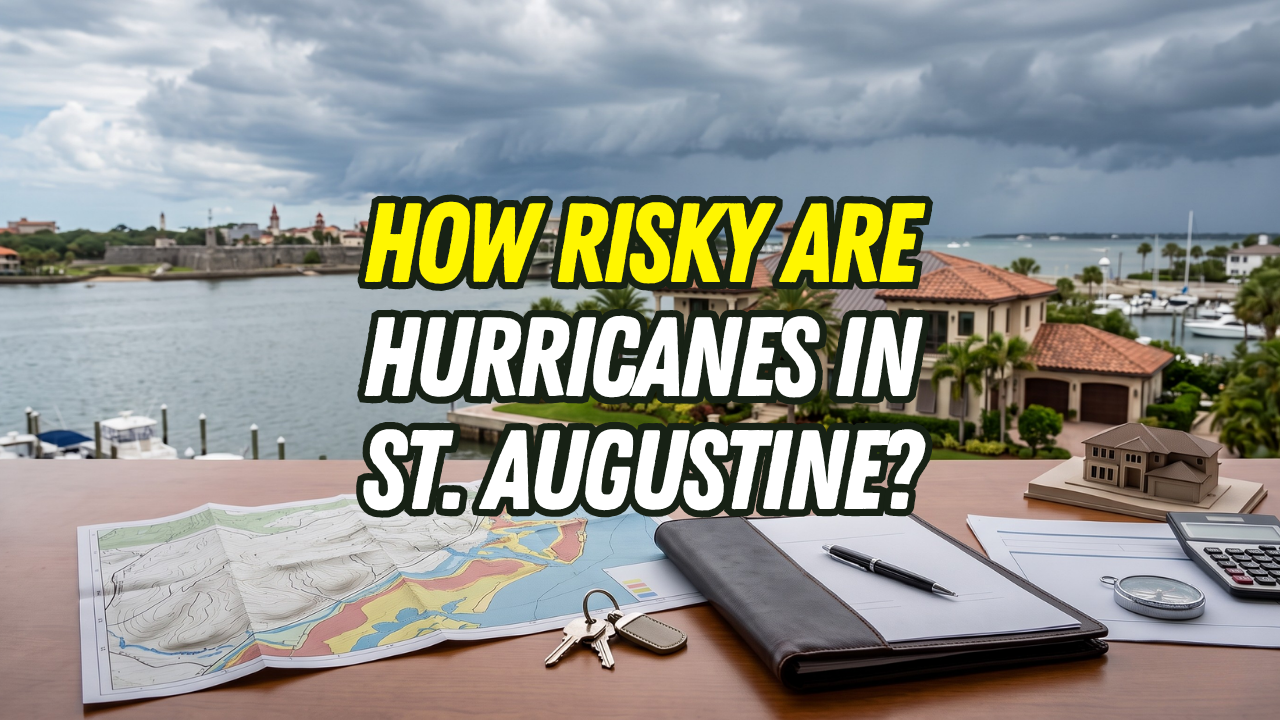
NOAA maintains historical tropical-cyclone tracks going back more than 150 years, and those records illustrate why hurricane risk should be viewed as recurring exposure rather than as a fixed timetable between direct hits.
- There is no reliable “once every X years” schedule. Hurricanes and tropical storms do not arrive at regular intervals.
- A direct landfall is not required for significant damage. Offshore or distant storms can still produce storm surge, flooding, wind, waves, and erosion.
- Flooding is an especially important local risk. The City of St. Augustine says approximately 90% of city residents live in a floodplain.
- Recent history matters. Hurricane Matthew caused significant flooding in 2016, and Hurricane Irma flooded many of the same areas in 2017.
- Risk varies dramatically from one property to another. Elevation, flood zone, distance from water, drainage, construction, roof condition, openings, and insurance options can matter more than a citywide hurricane statistic.
Why St. Augustine Can Be Affected Without Taking a Direct Hit
One of the biggest misconceptions about hurricane risk is that the eye of the hurricane has to cross the city for homeowners to have a problem. It does not.
Hurricanes are large weather systems. Depending on the size and path of a storm, hazards can extend well beyond the center. Wind is only one component. Storm surge, heavy rain, tidal flooding, coastal erosion, power outages, falling trees, and drainage problems can affect communities many miles away from the official landfall point.
Hurricane Matthew illustrates this clearly. In October 2016, Matthew moved northward just offshore of Florida's Atlantic Coast rather than making a direct St. Augustine landfall. The National Hurricane Center reported that the hurricane remained roughly 30 miles offshore during part of its passage along Florida's east coast. Even so, the City of St. Augustine reports that Matthew caused flooding in Davis Shores, Lincolnville, the Historic Districts, and portions of Abbott Tract.
That is why evaluating hurricane exposure solely by counting direct hits can create a false sense of security. For real estate purposes, impact history is generally more useful than landfall history alone.
Hurricane Irma provides another example. Irma made its major Florida landfalls much farther south in 2017, yet St. Augustine still experienced flooding. The city reports that Irma flooded many of the same areas affected by Matthew less than a year earlier.
For a buyer, that history changes the due-diligence question. Instead of asking only whether St. Augustine has been directly hit, you want to understand what has happened on the street, in the neighborhood, and—when records are available—at the specific property you are considering.
Flooding May Matter as Much as Hurricane Wind
When people hear “hurricane,” they often picture extreme wind. In St. Augustine, that is only part of the risk equation.
The City of St. Augustine identifies flooding as one of the area's common natural hazards. According to the city, approximately 90% of St. Augustine residents live in a floodplain. The city can experience flooding from combinations of rainfall and high tides, storm surge, coastal storms, tropical storms, hurricanes, overflowing waterways, and localized heavy rainfall.
The city's geography matters. Matanzas Bay, the San Sebastian River, Salt Run, Hospital Creek, Oyster Creek, Lake Maria Sanchez and other waterways can influence local flood exposure. Low elevations, coastal proximity and drainage limitations can make two homes only a short distance apart perform very differently during the same storm.
This is why buyers should avoid making assumptions based solely on neighborhood name or distance from the beach.
A property several blocks inland is not automatically low-risk. Conversely, a coastal property should not automatically be rejected simply because it is near water. The individual property's elevation, flood designation, construction, mitigation measures and insurance costs need to be evaluated together.
FEMA's Flood Map Service Center is the federal government's official source for National Flood Insurance Program flood-hazard information. FEMA also notes that flood maps change over time, so buyers should verify the current map for the actual address rather than relying on an old listing, prior owner's information, or a neighboring property.
What Buyers Should Check Before Purchasing a St. Augustine Home
Hurricane risk is manageable only when you understand what you are buying. A good due-diligence process should move from broad regional risk to property-specific facts.
Start with the flood zone. Check the current FEMA flood map for the property. Do not assume that a home is outside meaningful flood risk simply because a lender does not require flood insurance.
Then look at elevation. The property's elevation relative to expected flood levels may be more useful than the flood-zone letter by itself. When available, review an elevation certificate and ask questions if additions or substantial renovations have changed the structure.
Investigate prior flooding. Ask what is known about previous storm or water intrusion. A house that looks completely renovated today may have experienced flooding years earlier.
Examine the home's construction and mitigation features. Depending on the property, relevant items may include:
- Roof age and condition
- Roof-to-wall connections
- Impact-rated windows or shutters
- Exterior door protection
- Garage-door strength
- Finished-floor elevation
- Drainage around the structure
- Elevated mechanical or electrical equipment
- Generator or backup-power capability
- Tree condition and proximity to the structure
The City of St. Augustine specifically encourages residents to review flood risk, insurance, evacuation planning and ways to strengthen their homes before hurricane season. The city also notes that standard homeowners insurance generally does not cover flooding, making a separate review of flood insurance particularly important.
Get insurance information early. This is especially important for buyers. Do not wait until the final days before closing to determine whether the home is reasonably insurable at a cost that fits your budget.
Ask an insurance professional to evaluate the exact property. Premiums and coverage can depend on factors that are invisible in listing photos, and two similarly priced homes may have very different insurance economics.
What Homeowners and Investors Should Consider
If you already own property in St. Augustine, hurricane planning should be viewed as an ongoing ownership responsibility rather than something you address only when a named storm appears on the forecast.
Review insurance coverage periodically. Understand deductibles. Know whether you have flood insurance. Photograph the property and valuable contents. Keep important records accessible. Know your evacuation zone and route. Maintain shutters and other protective systems so they are usable when needed.
St. Augustine recommends year-round preparation, including reviewing flood exposure, insurance, evacuation plans and home-strengthening measures before a storm threatens.
For investors, there is an additional layer: hurricane risk affects more than physical damage. It can influence insurance expenses, reserves, maintenance budgets, tenant disruption, property access and operating assumptions.
A property may still be an attractive investment after those risks are considered. The point is to price the risk into the decision rather than discovering it after closing.
This is especially important when comparing properties in different parts of the St. Augustine area. A lower purchase price does not necessarily mean a lower total ownership cost if insurance, flood mitigation, maintenance or storm exposure is materially different.
Common Misconceptions About St. Augustine Hurricane Risk
“St. Augustine rarely takes a direct hit, so hurricane risk is low.”
Direct landfall is only one measure of risk. Matthew demonstrated that a hurricane remaining offshore can still cause substantial local flooding.
“If I am not on the beach, storm surge and flooding are irrelevant.”
Not necessarily. St. Augustine contains multiple waterways and low-lying areas, and the city identifies rainfall, tides, coastal storms and overflowing waterways as sources of flooding.
“A newer-looking house is automatically safer.”
Appearance does not establish hurricane resilience. You still need to investigate construction, permits, roof condition, openings, elevation, drainage and applicable building standards.
“If flood insurance isn't required, I don't need it.”
A lender's requirement and a property's actual flood exposure are not the same question. FEMA encourages property owners to investigate flood risk even outside the highest-risk zones, and standard homeowners insurance generally does not cover flooding.
Important Considerations Before You Buy
The most important takeaway is that hurricane risk should be evaluated property by property.
When comparing St. Augustine homes, consider creating a simple risk profile for each property:
- What FEMA flood zone is it in?
- What is the home's elevation?
- Has the property or surrounding street flooded before?
- What happened in the neighborhood during Matthew and Irma?
- What is the roof age?
- Does the home have documented wind-mitigation features?
- What will homeowners and flood insurance cost?
- What hurricane deductibles apply?
- Is the property in an evacuation zone?
- What access issues could arise if surrounding roads flood?
For historic properties, due diligence can require additional attention. The City of St. Augustine's flood-mitigation guidance notes that more than three-quarters of parcels in its local and National Register Historic Districts are within floodplains, underscoring the importance of understanding both preservation requirements and flood mitigation when evaluating older homes.
That does not mean historic homes should be avoided. It means buyers should know what questions to ask before committing.
What About the 2026 Hurricane Season?
As of August 6, 2026, NOAA's updated Atlantic hurricane outlook calls for 7–13 named storms for the full season, including 2–6 hurricanes and 0–2 major hurricanes. NOAA currently assigns a 75% probability to a below-normal Atlantic season.
That should not be interpreted as a St. Augustine landfall forecast. NOAA explicitly states that seasonal outlooks do not predict where storms will make landfall; local impacts are largely determined by shorter-term weather patterns as individual systems develop.
In practical terms, a quieter Atlantic season does not eliminate property risk. One storm moving along the wrong path can matter far more to a homeowner than the total number of storms across the entire Atlantic basin.
“What do you say about a real estate broker who helps you to safely, successfully, and timely navigate your way through the daunting process of purchasing a home from over a thousand miles away? ... Kim Devlin is truly the best of the best. I cannot recommend her highly enough!! Thank you for everything, Kim!!”— Vickie M.
Does St. Augustine get hit by hurricanes often?
St. Augustine does not experience direct hurricane landfalls on a predictable schedule. However, its coastal location means hurricanes and tropical storms can affect the area through flooding, storm surge, heavy rain, wind and erosion even if their centers pass offshore or make landfall elsewhere. NOAA's historical hurricane database is useful for reviewing tracks near a specific location rather than relying on a simplified recurrence number.
What is the biggest hurricane risk for homes in St. Augustine?
It depends on the individual property, but flooding deserves particular attention. The City of St. Augustine says about 90% of residents live in a floodplain and identifies storm surge, heavy rainfall, tides, tropical storms and hurricanes among its sources of flooding.
Should hurricane risk stop me from buying a home in St. Augustine?
Not necessarily. Hurricane exposure is one part of the decision. A more useful approach is to compare each home's flood exposure, elevation, construction, mitigation features, insurance costs, evacuation considerations and prior storm history before deciding whether the risk fits your goals.
Does homeowners insurance cover hurricane flooding?
Standard homeowners insurance generally does not cover flood damage. The City of St. Augustine recommends reviewing flood insurance separately, and FEMA's Flood Map Service Center provides the official federal source for checking a property's mapped flood hazard.
Understanding the Risk Before You Make a Decision
Living, buying or investing in St. Augustine means accepting that hurricanes are part of coastal Florida life. That does not mean every property carries the same risk, and it does not mean hurricane exposure should automatically prevent you from buying.
The goal is to understand the risk before you own it.
A property's flood zone, elevation, insurance costs, construction, storm history and location can tell you far more than a general statistic about how frequently hurricanes “hit” St. Augustine.
Next Steps
If you're considering buying, selling, or investing in St. Augustine, the Kim Devlin Team can help you evaluate the real estate side of that decision with local context.
That includes helping you compare neighborhoods and properties, identify questions worth investigating about flood and storm history, understand which property characteristics deserve closer attention, and coordinate the information you need from qualified insurance, inspection, flood, and other professionals.
Before deciding whether a St. Augustine property is right for you, contact the Kim Devlin Team and make hurricane and flood risk part of your property evaluation—not an afterthought after closing.
Real estate professionals are not substitutes for licensed insurance agents, engineers, floodplain specialists, inspectors, or government emergency-management authorities. Flood zones, insurance requirements, premiums, building conditions, and hurricane forecasts can change. Verify property-specific information with the appropriate professionals and government agencies before making a purchase or investment decision.
Check out this article next