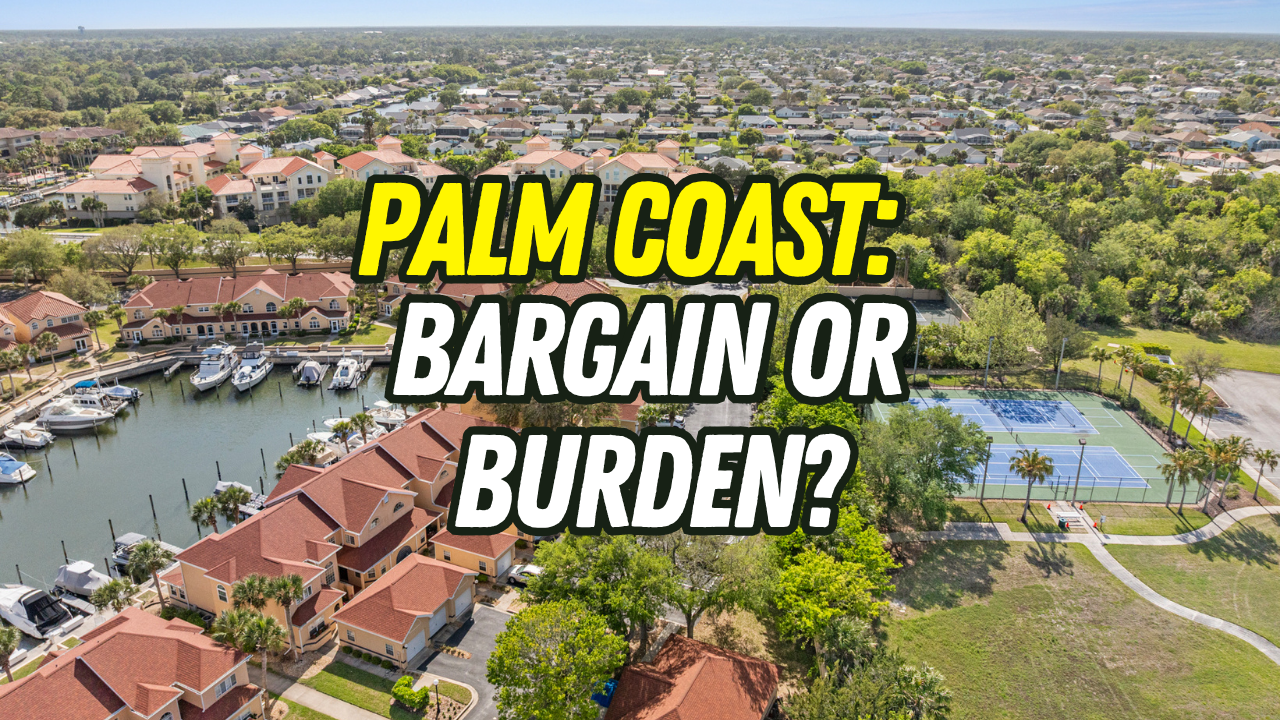
Yes, Palm Coast can still be a cheaper alternative to St. Augustine in 2026, but the better question is whether it is cheaper after insurance, flood risk, roof age, code rules, and infrastructure costs are included. Palm Coast may offer lower home prices, more inventory, quieter neighborhoods, and less tourism pressure, but buyers need to evaluate the full cost of ownership before treating it as the easy coastal Plan B.
Palm Coast is still generally more affordable than many better-known coastal markets nearby, including St. Augustine, but the gap is more complicated than it looks on a listing page.
- Palm Coast may offer more house for the money.
- Older homes may come with insurance friction.
- Canal homes may trigger flood-related costs.
- City code enforcement can feel like a “stealth HOA.”
- Infrastructure spending is becoming a bigger part of the ownership story.
- Town Center may offer stronger long-term upside than some older canal areas.
Palm Coast’s 2026 budget is a major reason buyers need to slow down and look beneath the surface. The City Council adopted a roughly $696 million fiscal year 2026 budget, about a 65% increase from the prior year, with the largest increase tied to water and wastewater infrastructure rather than ordinary general fund growth.
That does not mean Palm Coast is a bad buy. It means Palm Coast is no longer just a quiet, inexpensive, under-the-radar city. It is a growing coastal community paying for the systems it needs to support that growth.
Why does Palm Coast’s 2026 budget matter to homebuyers?
Palm Coast has reached its middle-age moment.
A lot of the city was built around the promise of affordable Florida living: trees, canals, space, no traditional HOA in many sections, and a quieter lifestyle than St. Augustine or other tourism-heavy markets. That story still exists, but it now sits next to another reality: aging systems, fast growth, and a large infrastructure bill.
The 2026 budget increase matters because buyers are not just buying the house. They are buying into the city’s next chapter.
When a city makes a large investment in water and wastewater infrastructure, that can be positive for long-term residents. Better systems, more capacity, and modernization can support future growth and quality of life. But it also means buyers should understand utility rates, assessments, taxes, and future capital needs before assuming Palm Coast is automatically the cheaper option.
This is especially important if you are moving from St. Augustine or St. Johns County because you may be comparing only purchase price. A Palm Coast house listed $75,000 or $100,000 below a similar St. Augustine option can look like an obvious win. But if the Palm Coast property needs a roof, has higher insurance costs, requires flood coverage, or sits in an area affected by older infrastructure, the real monthly cost may be closer than expected.
Palm Coast can still be a smart affordability play. It just needs to be analyzed as a total-cost decision, not a sticker-price decision.
Why is Palm Coast in a “sorting market” right now?
Palm Coast is not acting like the runaway seller’s market many people remember from 2021 through 2023.
Recent housing data shows a slower market. Median prices vary by source and neighborhood, but the real story is the slowdown. Homes are taking longer to sell, buyers are more selective, and sellers are often having to adjust expectations.
That creates what I call a sorting market.
Buyers are sorting properties by risk. Sellers are still sorting through expectations from the boom years.
A house may sit for 90, 120, or 180 days without being “bad.” It may simply have one of the issues buyers are now pricing more aggressively:
- An older roof
- Original electrical or plumbing
- Higher insurance quotes
- Four-point inspection concerns
- Flood insurance questions
- Deferred maintenance
- Overpricing based on 2022 expectations
In Florida, roof age has become a major insurance conversation. Once a roof starts approaching the 15-year mark, buyers, insurers, and lenders tend to look at the property differently. The house may still be structurally sound, but the insurance conversation changes.
The opportunity is in understanding the story behind the days on market. Long DOM is not always a warning sign. Sometimes it is leverage.
How should buyers negotiate in Palm Coast’s 2026 market?
The smartest Palm Coast buyers are not just asking, “What can I get this house for?”
They are asking, “What will this house cost me to own?”
That difference matters.
If you are serious about a Palm Coast property in 2026, start with three numbers before you get emotionally attached:
What is the insurance quote for this exact address?
Do not ask, “What does insurance cost in Palm Coast?” Ask an insurance broker to quote the specific home, roof age, location, flood zone, replacement cost, and condition.
What major repairs may be coming soon?
If the roof is older, the HVAC is near the end of its life, or the electrical panel raises concerns, build that into your offer. A house that looks affordable can become expensive quickly if you inherit several major systems at once.
What is the property’s flood and elevation risk?
Especially in canal neighborhoods, ask for an elevation certificate if available. Review FEMA flood maps, lender requirements, and Citizens Insurance rules before assuming flood coverage is optional.
This is where older homes can become opportunities. A dated house with one major issue may be a better buy than a polished house where the seller already baked in top-dollar expectations.
For example, if a home has been sitting because the roof is 17 or 18 years old, the seller may already know buyers are nervous. Instead of ignoring the issue, use it. Ask for a credit, price reduction, or other concession that reflects the real cost of future ownership.
The goal is not to beat up the seller. The goal is to price the house based on today’s market, not yesterday’s emotions.
Does Palm Coast really have no HOA?
This is one of the biggest misunderstandings about Palm Coast.
Many Palm Coast neighborhoods do not have a traditional HOA fee, especially in the lettered sections. But that does not mean there are no rules.
Palm Coast is a master-planned city, and city code enforcement can regulate issues that many buyers normally associate with an HOA: commercial vehicles, boats, trailers, sheds, fences, yard conditions, and parking standards.
That means “no HOA” does not always mean “do whatever you want.”
If you are a contractor, own a wrapped work van, have a boat, park a trailer, or run a small business from home, you need to check the rules before you buy. A driveway setup that works in one Florida community may create code issues in Palm Coast.
This is the trade-off.
The same rules that frustrate some residents also help keep many neighborhoods tidy and consistent. You may not have a board president sending letters, but you may still have city rules shaping what your property can look like.
Before buying, do three simple things:
- Read the City of Palm Coast code rules that apply to parking, vehicles, boats, trailers, fences, and sheds.
- Drive the neighborhood at night and on weekends to see how people actually live.
- Decide whether you want more freedom or a cleaner, more controlled neighborhood feel.
Palm Coast may be a great fit. Just do not buy it under the illusion that “no HOA” means no restrictions.
Are Palm Coast canal homes still a good buy?
Palm Coast canal homes can still be incredible, but they are no longer casual purchases.
The appeal is obvious. You get water in the backyard, boat access in many locations, and an Old Florida feel that is harder to find every year. For many buyers, the C-Section and other canal areas are exactly what they picture when they imagine moving to Palm Coast.
But the carrying costs need to be checked carefully.
Flood risk is part of the equation. A property does not have to look risky on a sunny day to carry long-term flood exposure. Buyers also need to understand that flood zones, evacuation zones, insurance rules, and lender requirements are not the same thing.
Citizens Insurance adds another layer. For many Florida homeowners, flood insurance requirements are being phased in based on coverage value and policy type. That is especially important for Palm Coast canal homes because many waterfront properties can fall into higher replacement-cost ranges.
Even if a property is technically in a lower-risk FEMA zone, flood insurance may still be required or strongly recommended depending on the insurance carrier, lender, replacement cost, or buyer’s risk tolerance.
Before buying a canal home, ask:
- Is there an elevation certificate?
- What is the base flood elevation?
- What is the current flood zone?
- What would flood insurance cost?
- Would Citizens require flood coverage?
- What is the home’s replacement cost, not just purchase price?
- How old are the roof, seawall, dock, HVAC, and major systems?
Canal living can still be worth it. But in 2026, it needs to be a numbers-first decision.
Where is the long-term opportunity in Palm Coast?
The long-term opportunity may not be only on the canals.
Town Center is one of the most important areas to watch because it represents what Palm Coast may become next. For years, Town Center felt like a big idea waiting for momentum. Now, the pieces are starting to look more serious.
Data infrastructure, healthcare, education, recreation, and civic investment can change how an area functions. Instead of being only a quiet residential city, Palm Coast may gradually develop stronger employment, education, and lifestyle anchors.
For buyers thinking seven to ten years out, this creates a different strategy. Instead of only chasing the romance of canal living, look for areas near:
- Town Center
- Major civic and community amenities
- Healthcare and education anchors
- New employment infrastructure
- Improved transportation and daily-use services
Is that as romantic as coffee on a dock? No.
But appreciation often follows utility, not romance. If Town Center becomes a stronger daily-life hub, nearby properties may benefit from changing demand over time.
Should St. Augustine buyers consider Palm Coast as Plan B?
Yes, St. Augustine buyers should consider Palm Coast, but not as a blind Plan B.
Palm Coast can make sense if you want more space, less tourism pressure, quieter streets, and generally lower purchase prices. It may also appeal if you are comfortable trading some historic charm for a more suburban, practical, master-planned environment.
But you need to run the full ownership test.
Before you choose Palm Coast over St. Augustine, compare:
- Purchase price
- Insurance quote
- Flood insurance
- Roof age
- Utility costs
- Property taxes
- Code restrictions
- Commute patterns
- Neighborhood lifestyle
- Resale profile
- Long-term infrastructure investment
The buyer who wins in Palm Coast is not the buyer who simply finds the cheapest house. It is the buyer who understands why the house is cheaper.
Sometimes the discount is real opportunity. Sometimes it is the market quietly pricing in risk.
What should buyers check before purchasing in Palm Coast in 2026?
Before you fall in love with a Palm Coast home, stress-test it.
Here is the practical buyer checklist:
- Get an insurance quote for the exact address.
- Confirm roof age through permits, seller disclosures, or inspection.
- Ask whether a four-point inspection will be required.
- Review flood zone and elevation information.
- Ask whether Citizens flood requirements may apply.
- Check utility, tax, and assessment exposure.
- Read Palm Coast code rules on parking, vehicles, boats, trailers, fences, and sheds.
- Drive the neighborhood during evenings and weekends.
- Compare inland sections, canal sections, and Town Center-adjacent areas differently.
- Build repairs and carrying costs into your offer.
Palm Coast is not one market. It is a collection of micro-markets.
The F-Section, R-Section, C-Section, Town Center, Palm Harbor, Indian Trails, Lehigh Woods, Pine Lakes, Grand Haven, and the Hammock all carry different buyer profiles, price points, risks, and upside.
Do not analyze Palm Coast as one flat number. Analyze the specific house, on the specific street, with the specific insurance and ownership profile.
FAQ
Is Palm Coast cheaper than St. Augustine?
Palm Coast is often cheaper than St. Augustine on purchase price, but buyers should compare total monthly ownership costs. Insurance, flood coverage, roof condition, utilities, taxes, and code restrictions can narrow the affordability gap.
Are Palm Coast canal homes risky?
Palm Coast canal homes are not automatically bad investments, but they require extra due diligence. Buyers should review elevation, flood zone, insurance requirements, seawall condition, dock condition, and long-term resale risk before purchasing.
Does Palm Coast have strict code enforcement?
Yes, Palm Coast has city code rules that can affect parking, commercial vehicles, boats, trailers, fences, sheds, and property appearance. Even without a traditional HOA, some neighborhoods may feel more regulated than buyers expect.
Is Town Center a good area to watch in Palm Coast?
Town Center is one of the most important areas to watch because it is tied to civic, technology, education, healthcare, and community amenity growth. Long-term buyers may want to study properties near Town Center and related development anchors.
What is the bottom line on Palm Coast in 2026?
Palm Coast is still one of Florida’s more compelling coastal-adjacent options, especially for buyers priced out of St. Augustine or looking for more space and less tourism pressure.
But in 2026, Palm Coast is not just “cheap coastal Florida.”
It is a growing city with a major infrastructure bill, stricter-than-expected code rules, an insurance market that can punish older homes, and canal areas where flood costs need to be understood before you buy.
The opportunity is still there. You just need to separate the bargain from the burden.
Next Steps
If you are considering Palm Coast as a more affordable alternative to St. Augustine, do not rely on list price alone. The right move is to evaluate the full ownership picture: insurance, flood exposure, roof age, code restrictions, neighborhood fit, and long-term resale potential.
The Kim Devlin Team can help you compare Palm Coast homes with a clear, numbers-first approach so you understand what you are buying before you make an offer. If you want local guidance on Palm Coast neighborhoods, canal properties, insurance considerations, or buyer strategy, contact the Kim Devlin Team before you start touring homes.
Contact the Kim Devlin Team to review your Palm Coast buying options and make a more informed move.
Check out this article next