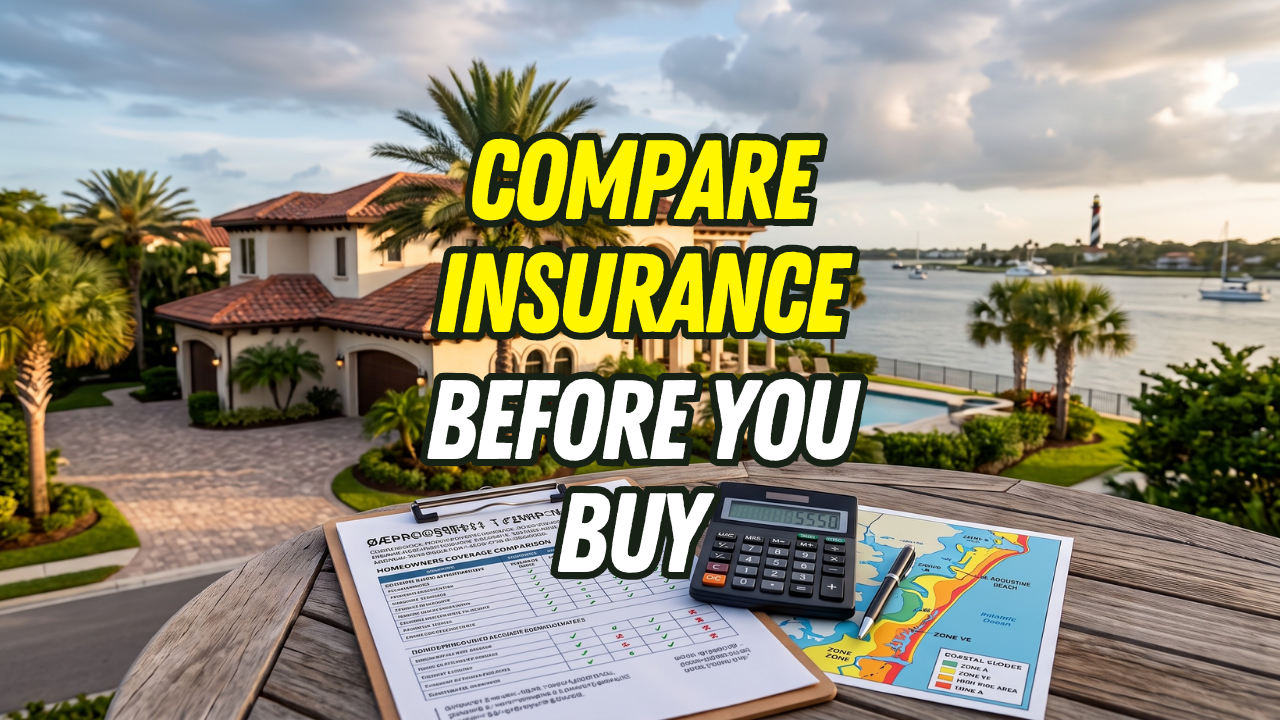
You can compare home insurance providers for St. Augustine properties through Florida’s official CHOICES rate comparison tool, licensed local insurance agents, independent insurance agencies, direct carrier quotes, FMAP, and flood-risk resources such as FEMA’s Flood Map Service Center. The best comparison should include price, coverage, deductibles, exclusions, flood risk, wind protection, and whether the policy fits the property’s use.
- Use the Florida Office of Insurance Regulation CHOICES tool to review sample homeowners insurance rate comparisons.
- Speak with licensed Florida insurance agents or independent agencies that can compare multiple carriers.
- Request direct quotes from insurance companies if you want to compare carrier-specific options.
- Use FMAP if you are having difficulty finding property insurance coverage in Florida.
- Check FEMA flood maps to understand flood zone considerations before comparing policies.
- Verify agent or agency licensing through Florida Department of Financial Services resources.
- Compare more than price. Review deductibles, exclusions, replacement cost, flood coverage, wind coverage, and claim support.
Start With Florida’s Official Insurance Comparison Resources
If you are buying or investing in a property in St. Augustine, one of the best starting points is the Florida Office of Insurance Regulation’s CHOICES homeowners rate comparison tool. This tool allows consumers to review sample average homeowners insurance rates based on predefined examples.
The important word is “sample.” CHOICES can help you understand how rates may vary by county, company, construction type, wind mitigation, and property assumptions, but it is not the same as a final quote for your specific home.
Your actual premium may depend on the property address, roof age, construction type, square footage, claim history, wind mitigation features, distance to water, flood zone, coverage limits, deductibles, and how the home will be used.
For that reason, the CHOICES tool is useful for research, but buyers should still request official quotes from licensed agents or insurance companies before making a purchase decision.
Another resource is the Florida Market Assistance Plan, commonly called FMAP. FMAP is designed to help Florida consumers find property insurance coverage for homes, rental properties, or vacation properties. This can be especially useful if you are having trouble finding coverage in the private market.
Compare Quotes Through Licensed Local and Independent Agents
For many St. Augustine buyers and investors, a licensed local or independent insurance agent is the most practical place to compare real quotes. An independent agent may be able to shop multiple carriers, while a captive agent usually represents one insurance company or a related group of products.
The right choice depends on what you need. If you want broad comparison, an independent agency may help you review several companies at once. If you already have a preferred insurer, a direct or captive quote may still be worth reviewing.
When speaking with an agent, ask them to compare policies using the same assumptions. That means the same dwelling coverage, personal property coverage, liability limits, deductibles, hurricane deductible, wind coverage, loss-of-use coverage, and replacement cost assumptions.
This matters because two policies can look similar at first glance but perform very differently after a claim. One may offer stronger replacement cost coverage. Another may have higher deductibles. Another may exclude or limit coverage that matters for the property.
Buyers should also verify that the agent or agency is properly licensed in Florida. The Florida Department of Financial Services provides license search tools that allow consumers to look up insurance license information.
A good agent should not simply send a quote and disappear. They should explain the coverage, exclusions, deductibles, inspection requirements, binding timeline, and what the lender may need before closing.
St. Augustine Buyers Should Compare Flood Insurance Separately
Homeowners insurance and flood insurance are not the same thing. Standard homeowners policies typically do not cover flooding from rising water, storm surge, or certain flood events. In a coastal and historic market like St. Augustine, flood risk should be reviewed early.
FEMA’s Flood Map Service Center is the official public source for flood hazard information produced for the National Flood Insurance Program. Buyers can use it to review official flood map information for a property, but they should also discuss flood risk with their lender, insurance agent, and real estate professional.
A lender may require flood insurance if the home is in a high-risk flood zone and the buyer is using financing. Even if flood insurance is not required, some buyers may still choose to purchase it based on location, elevation, storm history, or personal risk tolerance.
St. Augustine includes different property settings. A home near the water, a property closer to downtown, a coastal investment property, or a home in a low-lying area may create different insurance questions than a newer inland property.
Buyers should ask whether they are comparing National Flood Insurance Program coverage, private flood insurance, or both. They should also ask about waiting periods, coverage limits, contents coverage, loss-of-use coverage, deductibles, and whether the policy satisfies lender requirements.
Investors Need to Compare Coverage Based on Property Use
Investors should be especially careful when comparing home insurance providers in St. Augustine. A property used as a primary residence is not always insured the same way as a rental property, seasonal home, short-term rental, or vacant property.
If you plan to rent the property, ask whether the policy allows that use. Some policies may not cover short-term rentals, tenant-occupied homes, or vacancy periods unless the correct policy type or endorsement is in place.
Investors should also ask about liability protection, loss of rental income, ordinance or law coverage, flood insurance, umbrella policies, and whether the insurer has restrictions based on rental frequency.
If the property is a condo, the insurance comparison may be different. You may need to review the condo association’s master policy, understand what it covers, and determine what your individual policy needs to cover inside the unit.
Do not assume the cheapest policy is enough. For an investor, the wrong policy can create major risk if a claim is denied because the property use was not disclosed correctly.
Common Misconceptions About Comparing Home Insurance
One common misconception is that all home insurance quotes cover the same thing. They do not. Policies can vary by coverage limits, deductibles, roof settlement terms, exclusions, endorsements, claim handling, and underwriting requirements.
Another misconception is that the lowest quote is automatically the best option. A lower premium may come with a higher hurricane deductible, reduced water coverage, lower replacement cost protection, or exclusions that matter for the property.
Some buyers also assume flood insurance is included in homeowners insurance. In most cases, it is not. Flood coverage usually needs to be reviewed separately.
Investors may assume they can use a standard homeowners policy for a rental property. That can create problems. If the property will be rented, used seasonally, or held vacant during renovation, the policy needs to match the actual use.
Another misconception is that insurance can be handled at the last minute. In Florida, insurance should be reviewed early because quotes, inspections, roof age, wind mitigation, flood zones, and lender requirements can all affect closing.
Important Questions to Ask Before Choosing a Provider
Before selecting a home insurance provider for a St. Augustine property, ask detailed questions. A good quote should help you understand both the price and the protection.
- Is this an official quote or only an estimate?
- What dwelling coverage amount is being used?
- Is coverage based on replacement cost or actual cash value?
- What is the hurricane deductible?
- Are wind and hail included or excluded?
- Is water damage coverage limited?
- Is flood insurance required or recommended?
- Does the policy fit the property’s use as a primary home, second home, rental, or investment property?
- Are there roof age, electrical, plumbing, or inspection requirements?
- What documents will the lender need before closing?
The goal is not simply to find a policy. The goal is to find coverage that fits the property, satisfies the lender, protects your risk, and makes sense for your budget.
FAQ
Where can I compare home insurance providers for properties in St. Augustine, FL?
You can compare options through the Florida Office of Insurance Regulation CHOICES tool, licensed Florida insurance agents, independent insurance agencies, direct carrier quotes, FMAP, and flood-risk tools such as FEMA’s Flood Map Service Center.
Should I use a local insurance agent or an online quote tool?
Both can be useful. Online tools can help you gather quick estimates, while local or independent agents may provide more property-specific guidance, especially for coastal, older, rental, or flood-prone properties.
Do I need flood insurance in St. Augustine?
It depends on the property, flood zone, lender requirements, and your personal risk tolerance. Standard homeowners insurance usually does not cover flooding, so flood coverage should be reviewed separately.
Can investors compare the same insurance policies as regular homeowners?
Investors should compare policies based on property use. Rental homes, short-term rentals, vacant properties, and second homes may require different coverage than a primary residence.
What should I compare besides the premium?
Compare deductibles, replacement cost terms, hurricane deductible, wind coverage, water damage limits, exclusions, flood options, liability protection, company stability, and claim support.
Next Steps
Comparing home insurance providers for a St. Augustine property is not just about finding the lowest premium. Buyers and investors should compare coverage quality, flood risk, deductibles, property use, lender requirements, and the long-term risk of the home.
If you are buying or investing in St. Augustine and want to understand which insurance questions to ask before making an offer, contact the Kim Devlin Team. A local real estate team can help you think through insurance considerations, property type, flood risk, inspection timing, and the questions that matter before closing.
Check out this article next