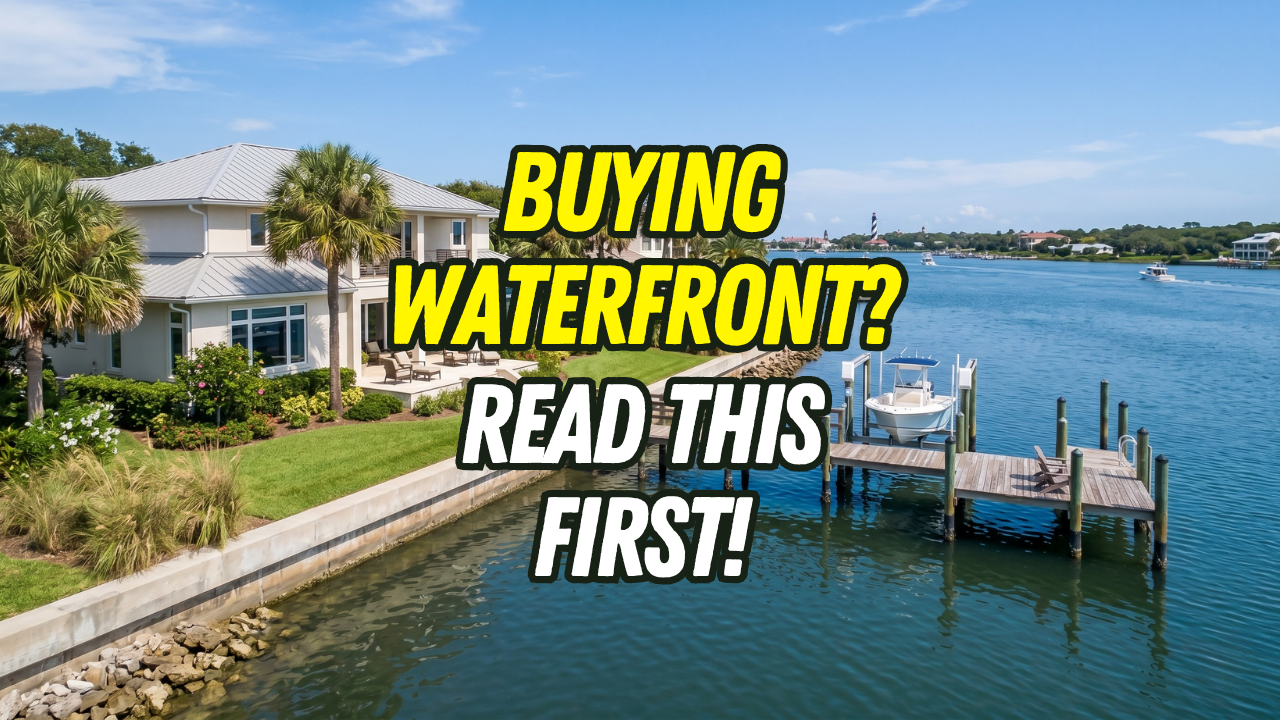
Waterfront buyers in St. Augustine should verify the legal type of water access, whether that access is deeded or shared, the property’s flood zone, existing dock and seawall permits, shoreline improvement restrictions, and insurance implications before making an offer. A property may look like it offers usable waterfront access, but the legal rights, permitting limits, and flood exposure can change the true value of the purchase.
- Confirm whether the water access is private, shared, deeded, licensed, or informal.
- Review the deed, survey, plat, easements, HOA rules, and title exceptions.
- Check the FEMA flood zone and ask for any available elevation certificate.
- Verify whether existing docks, boat lifts, seawalls, bulkheads, or shoreline structures were properly permitted.
- Confirm whether future dock, seawall, dredging, or shoreline improvements are legally allowed.
- Speak with qualified insurance, permitting, marine construction, and real estate professionals before waiving due diligence.
Why Waterfront Due Diligence Matters in St. Augustine
Waterfront property in St. Augustine can be highly desirable, but it also requires a deeper level of review than a typical inland purchase. The value is not only in the house. It is also in the access, the shoreline condition, the permitted improvements, the flood exposure, and the future usability of the property.
A buyer may assume that a property with water behind it automatically allows boating, docking, kayaking, fishing, or future shoreline improvements. That assumption can be expensive. Some properties have direct navigable access. Others may have scenic water frontage but limited practical use. Some may include a dock that was permitted years ago. Others may have structures that need repair, replacement, or documentation before a buyer can feel comfortable moving forward.
Flood risk also deserves careful attention. The City of St. Augustine directs property owners and buyers to flood zone maps and Planning and Building Department assistance for floodplain questions, flood hazards, historical flooding, local drainage, and elevation certificates.St. Johns County also states that its Floodplain Management Department regulates development in Special Flood Hazard Areas and reviews flood zone determinations, elevation certificates, and substantial improvement or damage determinations.
The goal is not to scare buyers away from waterfront property. The goal is to make sure the property actually supports the lifestyle, investment plan, and future improvements the buyer has in mind.
What Type of Water Access Does the Property Actually Have?
The first question is simple: what kind of water access are you really buying? In St. Augustine, waterfront can mean oceanfront, Intracoastal Waterway frontage, canal frontage, marsh frontage, river frontage, creek frontage, or a property near water with a community access point. Each one carries different practical and legal considerations.
A property may advertise “waterfront” because it overlooks water, but that does not automatically mean the buyer can install a dock, launch a boat, cross neighboring land, or use the shoreline in a specific way. The listing description should never be the only source of truth. Buyers should verify the actual rights through documentation.
Important documents to review may include:
- The deed
- The current survey
- The recorded plat
- Title commitment exceptions
- Recorded easements
- HOA or community association documents
- Dock agreements or slip assignments
- Prior permits for docks, lifts, seawalls, or shoreline work
Buyers should also ask whether the water is navigable for the intended use. A property may technically sit on water but still be too shallow, restricted, environmentally sensitive, or impractical for the buyer’s boat. Access at high tide may not be the same as access at low tide. A canal may not accommodate all vessel sizes. A scenic marsh view may not allow any dockage at all.
This is why waterfront due diligence should connect the legal rights with the buyer’s intended use. If the buyer wants a boat lift, verify whether one exists, whether it was permitted, whether it can be replaced, and whether the water depth works. If the buyer wants kayaking or paddleboarding, confirm safe and lawful access. If the buyer wants rental or investment use, confirm whether waterfront amenities can legally be advertised and used by guests.
Is the Water Access Deeded, Shared, Private, or Informal?
Water access should be verified in writing. A verbal statement that “everyone uses the dock” or “the neighbor has always allowed access” is not enough. Buyers need to know whether the access is deeded, licensed, shared, assigned, leased, controlled by an association, or simply informal.
Deeded access is generally stronger than informal access because it is tied to recorded property rights. Shared access may still be valuable, but the rules matter. Who maintains the dock? Who pays for repairs? Are there limits on boat size? Is the access transferable to a new owner? Can guests or tenants use it? Can it be revoked?
Community dock access can also vary. Some neighborhoods have assigned slips. Others offer first-come, first-served access. Some allow short-term docking only. Others have waitlists, use restrictions, or separate fees. For investors, the question becomes even more specific: can renters or guests use the dock, ramp, slip, or waterfront amenity?
Buyers should also confirm whether any access crosses another person’s land. If it does, the easement language matters. The easement should clearly explain who may use it, for what purpose, and under what conditions. A vague or missing easement can create future conflict.
The practical rule is this: if the water access affects the value of the property, it should be documented, reviewed, and understood before closing.
What Flood Zone Is the Property In?
Flood zone review is one of the most important steps in a St. Augustine waterfront purchase. Flood zones may affect insurance requirements, financing, renovation plans, elevation standards, future resale, and total cost of ownership.
Buyers should not rely only on listing remarks or assumptions based on proximity to water. The FEMA Flood Map Service Center allows users to search flood maps by address, and FEMA notes that homeowners insurance generally does not cover flood damage. For local review, St. Johns County offers GIS tools that allow users to search by address, parcel number, street name, and other property information.
In practical terms, buyers should ask:
- What FEMA flood zone is the property in?
- Is the home in a Special Flood Hazard Area?
- Is an elevation certificate available?
- Has the property experienced prior flooding?
- Are there local drainage concerns?
- Will the lender require flood insurance?
- What would flood insurance likely cost?
- Would future renovations trigger additional floodplain requirements?
This matters because a waterfront home with a lower purchase price may not be a better deal if insurance, elevation requirements, repairs, or future limitations are significant. The buyer needs to understand the full ownership picture, not just the asking price.
Flood zone review should happen early in the contract period. Waiting until late in due diligence can create pressure, rushed decisions, or avoidable surprises.
Are Docks, Boat Lifts, Seawalls, or Shoreline Improvements Allowed?
Buyers should never assume they can build, repair, expand, or replace a dock or seawall just because one exists nearby. Waterfront construction in Florida can involve local, state, and sometimes federal review, depending on the property, waterbody, submerged lands, wetlands, environmental conditions, and scope of work.
The Florida Department of Environmental Protection explains that Environmental Resource Permitting regulates many alterations to land surface and that dredge or fill activities may also fall under State 404 permitting. DEP advises property owners to contact the appropriate district office to determine what type of permit is needed. Dock guidance also notes that regulatory and proprietary authorizations are reviewed together and both must be approved for certain dock, pier, or marina permits.
For buyers, the key issue is not only whether something can be built. It is whether the desired improvement is legally, physically, and financially realistic. A buyer who wants to add a boat lift, extend a dock, replace a seawall, dredge a shallow area, or stabilize a shoreline should investigate before closing.
Questions to ask include:
- Was the existing dock or seawall properly permitted?
- Are there open permits, expired permits, or unresolved violations?
- Can the existing structure be repaired, or would replacement require new approvals?
- Are there submerged land, wetland, seagrass, marsh, or habitat concerns?
- Does the property fall under city, county, state, or federal jurisdiction?
- Will a licensed marine contractor or engineer need to inspect the structure?
- Are there HOA or architectural restrictions on waterfront improvements?
St. Johns County explains that building permit applications are reviewed by county staff and, in many cases, require a clearance sheet before permit acceptance. The county also notes that applicants need the parcel ID number to begin the permit process. Within the City of St. Augustine, building permit information directs applicants through local permit processes and notes that historic, planning, zoning, impervious surface, and lot coverage issues may apply depending on the project.
For a waterfront buyer, this means the right question is not “Can I add a dock someday?” The better question is “What written evidence shows that this property can support the dock, seawall, lift, or shoreline improvement I want?”
What Misconceptions Should Waterfront Buyers Avoid?
One common misconception is that waterfront always means boatable. It does not. Some waterfront properties offer views, not usable boating access. Others may be boatable only at certain tides or only for smaller vessels.
Another misconception is that existing structures are automatically legal. A dock, lift, seawall, bulkhead, or shoreline improvement may have been built years ago, repaired without documentation, or modified beyond the original approval. Buyers should ask for permits, final inspections, surveys, and contractor records when available.
A third misconception is that flood insurance is the only flood-related concern. Insurance is important, but flood zones can also affect renovation plans, rebuilding standards, substantial improvement calculations, elevation requirements, and future resale. St. Johns County specifically notes that floodplain regulations apply to development located wholly or partially within Special Flood Hazard Areas, including zones such as A, AE, AH, AO, and VE.
Buyers should also avoid assuming that a neighbor’s improvement sets a precedent. Waterfront permitting is property-specific. A neighboring dock or seawall does not guarantee that the subject property can receive the same approval.
What Should Buyers Confirm Before Making an Offer?
Before making an offer on waterfront property in St. Augustine, buyers should decide what matters most. Is the priority boating? Water views? Rental income? Long-term investment? Privacy? Dockage? Storm resilience? The due diligence should match the intended use.
A strong waterfront offer strategy may include contingencies or review periods for:
- Survey review
- Title and easement review
- Flood zone and insurance review
- Elevation certificate review
- Dock, seawall, or marine structure inspection
- Permit history review
- HOA or association document review
- Environmental or shoreline improvement feasibility
Buyers should also ask the seller for copies of any permits, engineering documents, invoices, warranties, maintenance records, inspection reports, and correspondence related to waterfront structures. If documents are missing, that does not automatically mean the property is a bad purchase. It does mean the buyer should slow down and verify.
The best waterfront purchases are made with clear expectations. The buyer knows what is included, what is permitted, what is restricted, what may cost more later, and what professionals need to review before closing.
“Kristen Pytel and her team have gone over and above the call of duty! Excellent experience! Communication quality and speed top notch! Professional and friendly! Highly recommend and look forward to the next time!” — Chris L.
FAQ
Does waterfront property always include private water access?
No. Waterfront property does not always include private or deeded water access. Buyers should verify the deed, survey, plat, easements, HOA documents, and title exceptions before assuming they have legal access to the water.
Can I build a dock or seawall on waterfront property in St. Augustine?
Maybe. Dock, seawall, boat lift, and shoreline work may require local, state, and sometimes federal approvals. Buyers should verify existing permits and consult the appropriate agencies or qualified marine professionals before relying on future improvement plans.
Why does the flood zone matter when buying waterfront property?
The flood zone can affect insurance, financing, renovation rules, future rebuilding standards, and long-term ownership costs. Buyers should confirm the property’s FEMA flood zone and request any available elevation certificate before waiving due diligence.
Should investors review waterfront rules differently than primary-home buyers?
Yes. Investors should confirm whether guests or tenants may use docks, slips, lifts, boat ramps, or waterfront amenities. They should also verify insurance costs, rental restrictions, HOA rules, and whether waterfront features can legally be marketed as part of the rental offering.
Next Steps
Before buying waterfront property in St. Augustine, take the time to verify the details that affect real value: water access, deeded rights, flood zone status, insurance exposure, dock and seawall permits, and future shoreline improvement options.
For help reviewing waterfront property details before you make an offer, call the Kim Devlin Team. A careful review upfront can help you understand what you are buying, what questions to ask, and which professionals should be involved before closing.
Check out this article next