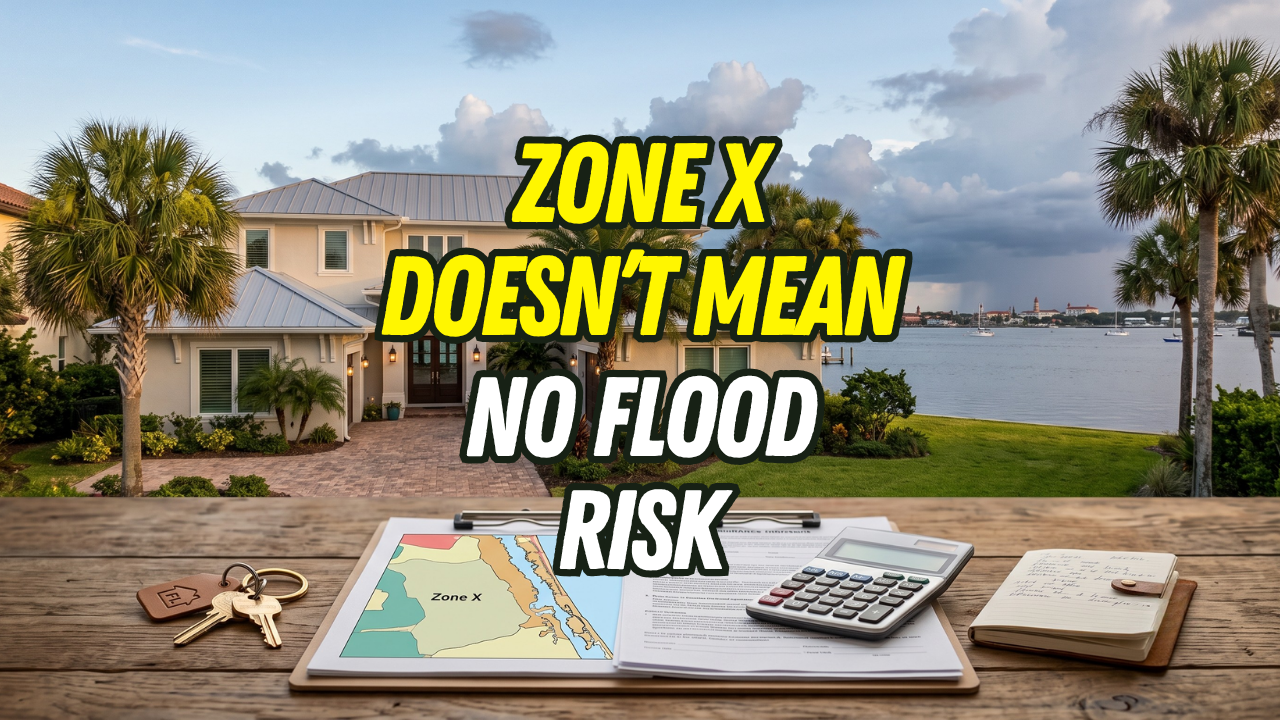
Usually, flood insurance is not federally required for a home in FEMA Zone X, but that does not mean the property has no flood risk. Your lender may still require coverage, and many St. Augustine buyers choose to carry it because standard homeowners insurance generally does not cover flood damage.
- Zone X is generally considered a lower- or moderate-risk flood zone rather than a Special Flood Hazard Area.
- Federal mandatory-purchase rules generally apply to buildings in Special Flood Hazard Areas, not Zone X.
- A mortgage lender may still require flood insurance as a condition of the loan.
- Zone X does not mean “no flood risk.” Every property has some level of risk.
- Most standard homeowners policies do not cover damage caused by flooding.
- The right decision depends on the specific property, not the zone label alone.
If you are buying a home in St. Augustine and the listing says “Zone X,” it is easy to assume flood insurance is unnecessary. That conclusion may be too simple. Zone X can reduce the likelihood that coverage will be required under federal lending rules, but it does not eliminate the possibility of flooding or the financial consequences of an uninsured loss.
FEMA uses flood maps to identify relative flood risk and help lenders determine when federal flood-insurance requirements apply. Zone X generally represents areas outside the mapped Special Flood Hazard Area. Depending on the map, Zone X may be shaded or unshaded, with the shaded designation generally reflecting moderate risk and the unshaded designation reflecting lower mapped risk.
The key word is mapped. A flood map is a risk-management tool, not a guarantee. Local drainage, rainfall intensity, nearby construction, elevation differences, storm surge, and changes in the surrounding land can affect an individual property differently than the broad zone designation suggests.
For St. Augustine buyers, the practical answer is this: you may not be federally required to purchase flood insurance for a Zone X property, but you should still investigate the risk and price the coverage before deciding against it.
What Zone X Actually Tells You—and What It Does Not
Zone X tells you that the property is outside FEMA’s mapped high-risk Special Flood Hazard Area. That distinction matters because federal rules generally require flood insurance for certain federally regulated or backed loans when the building is located in a Special Flood Hazard Area.
For a property in Zone X, the federal mandatory-purchase rule generally does not apply. However, a lender can apply stricter underwriting requirements and may still require a policy. This is why the answer should come from the lender’s written flood determination for the specific address, not from a listing description or a general neighborhood map.
Zone X also does not tell you whether the home has flooded before, whether the lot sits lower than nearby properties, or whether drainage backs up during heavy rain. It does not tell you whether a garage, crawlspace, pool equipment, detached structure, or personal belongings are especially vulnerable.
Before you rely on the zone designation, review:
- The current FEMA Flood Insurance Rate Map for the exact address
- The lender’s flood-zone determination
- The elevation of the structure and surrounding lot
- Any available elevation certificate or survey
- Seller disclosures and known flood history
- Drainage patterns and nearby low-lying features
- Quotes from NFIP-participating and private flood insurers
A buyer should also confirm whether the flood-zone designation applies to the building itself or only part of the parcel. A large lot can cross more than one mapped zone. The location of the insured structure is what typically matters for a lender’s determination.
Why Some Zone X Owners Still Buy Flood Insurance
The strongest reason is simple: reduced risk is not the same as no risk. FEMA states that every zone carries some flood risk, and the National Flood Insurance Program reports that a meaningful share of flood claims occurs outside current high-risk areas.
Another reason is the gap in standard homeowners coverage. Homeowners insurance commonly covers certain types of water damage, such as a sudden plumbing failure, but it generally does not cover flooding caused by rising surface water. Without a separate flood policy, the homeowner may be responsible for repair costs after a flood event.
Buyers should consider both the probability of a loss and the size of a possible loss. Even a few inches of water can damage flooring, drywall, electrical systems, cabinetry, appliances, and personal property. A buyer who could not comfortably pay for those repairs out of pocket may find that flood coverage provides valuable financial protection even when the lender does not require it.
Flood-insurance premiums are property-specific. The cost may reflect the home’s location, construction, elevation, replacement cost, and other risk factors. Request an actual quote rather than relying on a neighbor’s premium or a broad estimate.
When comparing homes, add the quoted flood premium to your all-in ownership cost. A policy costing $1,200 per year, for example, would add approximately $100 per month when viewed as part of your annual housing budget. That is only an illustration—not a St. Augustine rate quote—and the actual premium may be higher or lower.
Important Questions to Ask Before You Waive Coverage
Start with your lender. Ask whether flood insurance is required for the specific property and request the flood determination in writing. Do not assume that Zone X automatically settles the issue, because lenders can require coverage even when federal law does not.
Next, speak with a licensed insurance professional who understands Northeast Florida. Ask for a flood quote alongside the homeowners quote so you can evaluate the cost before the inspection or financing deadlines become urgent.
- Is this property in shaded or unshaded Zone X?
- Has the structure or parcel ever had a flood claim?
- Has the seller experienced water intrusion or drainage problems?
- Is there an elevation certificate, survey, or benchmark available?
- What are the building and contents coverage limits?
- What deductibles and exclusions apply?
- Is temporary living expense covered?
- Is the quote through the NFIP, a private carrier, or both?
- Is there a waiting period before coverage becomes effective?
You should also look beyond the current map. Flood maps can be updated, and development or environmental changes can alter drainage and risk. A home that is in Zone X today may not remain in the same mapped designation forever.
For investors, the analysis should include business interruption, tenant displacement, repair reserves, and the effect of a future flood event on rentability and resale. For primary-home buyers, the decision may be more personal: how much uninsured risk can you realistically absorb without disrupting your finances?
“Working with Kim Devlin has been an absolute pleasure and a true example of what outstanding collaboration between a real estate agent and a mortgage broker should look like. From the very beginning, Kim demonstrated a level of professionalism, responsiveness, and deep market knowledge that made our shared client's home buying experience smooth and successful. Kim is a consummate professional in every sense of the word. She brings a calm confidence to every transaction and consistently goes above and beyond to ensure her clients are informed, comfortable, and positioned for the best outcome. Her ability to navigate complex situations with ease and grace makes her a standout in the industry.
As a mortgage broker, I work with many agents, but working alongside Kim felt like true teamwork. Communication was seamless, timelines were met with precision, and our client was always the top priority. She’s not only a subject matter expert when it comes to real estate—she’s also a trusted advisor, a strong advocate for her clients, and a joy to work with. If you're looking for a real estate professional who truly knows her craft and collaborates effortlessly with all parties involved, I can't recommend Kim Devlin highly enough. I look forward to many more transactions together!” — Michael S.
FAQ
Is flood insurance required for a Zone X home in St. Augustine?
Usually not under the federal mandatory-purchase rule, because Zone X is outside the mapped Special Flood Hazard Area. However, your lender may still require coverage, so confirm the requirement for the exact property before closing.
Does Zone X mean the property cannot flood?
No. Zone X represents lower or moderate mapped risk, not zero risk. Heavy rainfall, drainage failures, storm surge, nearby development, and property elevation can still contribute to flooding.
Will my homeowners policy cover flood damage?
Most standard homeowners policies do not cover flood damage caused by rising water. Separate flood insurance is generally needed for that exposure.
Can a lender require flood insurance even when FEMA shows Zone X?
Yes. A lender may impose a flood-insurance requirement as a condition of financing even when the property is not subject to the federal mandatory-purchase rule.
How do I decide whether the policy is worth it?
Compare the annual premium with the property’s specific risk, prior history, elevation, drainage, coverage limits, deductibles, and your ability to pay for an uninsured loss. The decision should be based on the property and your finances, not the Zone X label alone.
Next Steps
Buying in Zone X can reduce one concern, but it should not end your flood-risk review. The best decision comes from combining the current FEMA map with the lender’s determination, seller disclosures, property elevation, local conditions, and real insurance quotes.
Contact the Kim Devlin Team for help evaluating a St. Augustine property before you buy. The team can help you identify the questions to ask, coordinate with your lender and insurance professionals, and compare the full ownership costs of different homes so you can make a more informed decision.
This article provides general educational information and is not legal, lending, insurance, engineering, or floodplain-management advice. Requirements, maps, policies, premiums, and property conditions can change. Verify all information for the specific property with the appropriate licensed professionals and government sources.
Check out this article next