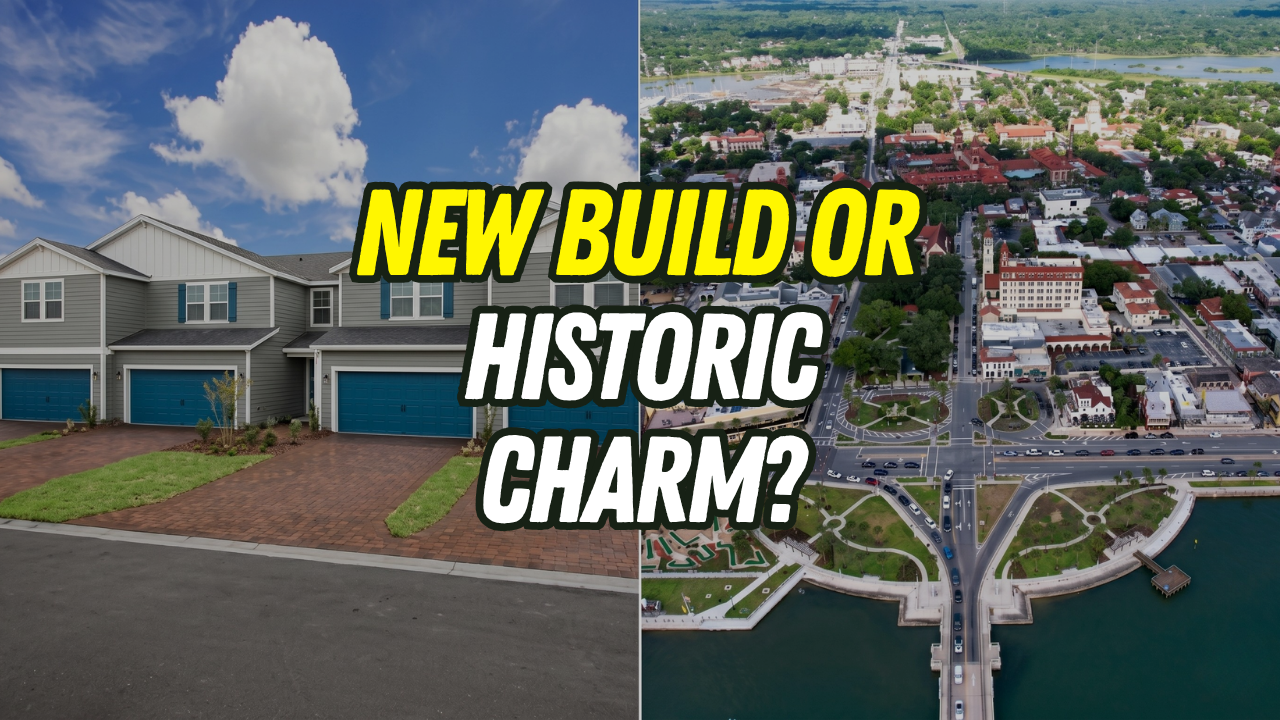
New construction in St. Augustine is usually better if you want modern layouts, newer systems, warranties, energy efficiency, and fewer near-term repair concerns. Historic homes are usually better if you value character, walkability, mature neighborhoods, architectural detail, and proximity to places like Historic Downtown, Lincolnville, Uptown, and Davis Shores. The right choice depends on your budget, lifestyle, maintenance tolerance, insurance comfort, and whether you want convenience or character.
Should you buy new construction or a historic home in St. Augustine?
- Choose new construction if you want modern floor plans, updated building systems, builder warranties, and less immediate maintenance.
- Choose a historic home if you want architecture, charm, mature streets, walkability, and a stronger connection to St. Augustine’s history.
- Look closely at insurance and flood exposure because coastal, island, and historic areas can have different ownership costs.
- Review renovation rules before buying because some historic properties may involve design guidelines, permits, or Historic Architectural Review Board review.
- Compare full ownership cost, not just purchase price, including taxes, insurance, HOA fees, CDD fees, maintenance, repairs, and future resale.
- Match the home to your lifestyle because Historic Downtown, Lincolnville, Uptown, Davis Shores, Anastasia Island, St. Augustine Beach, Vilano Beach, and newer communities all feel different.
Why is the new construction vs. historic home decision different in St. Augustine?
St. Augustine is not a typical Florida housing market. Buyers are often choosing between two very different versions of homeownership: a newer home with modern convenience or an older home with historic character. That choice matters more here because St. Augustine has a rare combination of historic neighborhoods, coastal exposure, tourism, architectural preservation, island communities, and newer suburban growth.
A buyer looking in Historic Downtown, Lincolnville, or Uptown may be drawn to walkability, porches, original details, mature trees, and streets with a strong sense of place. A buyer looking near newer-construction communities around St. Augustine may care more about open layouts, garages, energy efficiency, larger closets, modern kitchens, and lower near-term maintenance. Both can be good decisions, but they solve different problems.
The mistake is assuming the comparison is only about “old versus new.” It is really about lifestyle, risk, cost, control, and long-term ownership. A historic home may offer a location and character that cannot be recreated. A new construction home may offer predictability and function that older homes often cannot match without major renovation.
St. Augustine’s official city resources also make clear that certain construction, renovation, demolition, and exterior work may require additional review, including Historic Architectural Review Board processes and design guideline compliance. That does not mean historic homes should be avoided. It means buyers should understand the rules before making assumptions about what they can change.
Who is new construction in St. Augustine better for?
New construction is often the better fit for buyers who want a simpler ownership experience. You may prefer new construction if you want a modern kitchen, open floor plan, larger primary suite, updated electrical systems, newer plumbing, current roof standards, energy-efficient windows, and a layout designed for how people live today.
For relocation buyers, this can be especially important. If you are moving from out of state, you may not want to begin your Florida life with an older roof, aging HVAC system, outdated wiring, cast iron plumbing concerns, termite history, or a long list of renovation decisions. A newer home can reduce uncertainty, especially during the first few years of ownership.
New construction may also appeal to investors and second-home buyers who want fewer immediate repair variables. Newer systems can make budgeting easier, although investors still need to evaluate HOA rules, CDD fees, rental restrictions, taxes, insurance, and realistic rent or resale demand.
The tradeoff is location and character. Many newer communities around St. Augustine are not in the historic core. You may get the modern home, but you may also be farther from downtown restaurants, older neighborhood charm, or beach access. Some new communities also come with HOA rules, architectural standards, amenity fees, and CDD fees that need to be reviewed carefully before purchase.
New construction is not automatically easier or cheaper. It is usually more predictable, but buyers still need to inspect the property, review the builder contract, understand warranty coverage, compare upgrade costs, and confirm the total monthly ownership number.
Who is a historic home in St. Augustine better for?
A historic home is often the better fit for buyers who value character more than convenience. If you want original architecture, older streets, mature landscaping, front porches, walkability, and a home that feels connected to the story of St. Augustine, a historic property may be the right match.
Areas like Historic Downtown, Lincolnville, and Uptown attract buyers who want more than square footage. They want a setting. They want proximity to restaurants, galleries, the bayfront, historic sites, and neighborhood streets that do not feel like every other Florida suburb. Davis Shores can also appeal to buyers who want island proximity with access to both downtown and Anastasia Island.
The tradeoff is maintenance and complexity. Historic homes can have older roofs, older foundations, outdated electrical systems, aging plumbing, moisture issues, window concerns, wood rot, termite exposure, and prior renovations that were not completed to today’s standards. Some homes have been beautifully updated. Others need careful inspection and realistic budgeting.
Historic homes may also involve more rules around exterior changes, additions, demolition, or alterations, depending on the home’s location and status. St. Augustine’s historic preservation resources describe the city’s role in protecting historic buildings, sites, archaeological resources, and design integrity. Buyers should confirm what rules apply before assuming they can modify a property freely.
A historic home can be a strong long-term asset when the buyer understands what they are buying. The key is not to romanticize the home. Love the character, but inspect the structure.
“Kim was a dream to work with; I was extremely pleased with her responsiveness and her communication. Definitely will use her again!!!” —Kimberly J.
How do Historic Downtown, Lincolnville, and Uptown compare with newer-construction communities?
Historic Downtown, Lincolnville, and Uptown are usually better for buyers who want character, walkability, architecture, and a strong sense of place. These areas can offer older homes, renovated cottages, historic properties, smaller lots, mature trees, and access to the cultural center of St. Augustine.
The daily experience is different from a newer community. You may walk to coffee, restaurants, shops, events, or the bayfront. You may live on a street where every home looks different. You may also deal with parking limitations, tourist traffic, older infrastructure, smaller closets, uneven floors, or more maintenance.
Newer-construction communities around St. Augustine usually offer a more modern and controlled lifestyle. You may get a larger garage, open kitchen, community amenities, sidewalks, newer systems, and a builder warranty. The neighborhood may be easier to maintain and more predictable, but it may not have the same historic identity.
The best choice depends on what you want your daily life to feel like. If you want charm and proximity, historic neighborhoods may win. If you want function and predictability, newer communities may be better.
How do Anastasia Island, St. Augustine Beach, and Vilano Beach change the decision?
Anastasia Island, St. Augustine Beach, and Vilano Beach add another layer to the decision because beach proximity changes both lifestyle and ownership cost. Buyers looking in these areas often want coastal access, ocean breezes, beach walks, restaurants, and a more relaxed daily rhythm.
These areas can include a mix of older homes, renovated beach properties, condos, townhomes, and newer construction. The question is not only whether the home is new or historic. The question is also how close it is to the ocean, what flood zone it sits in, what insurance may cost, and how the property has been maintained in a coastal environment.
Coastal exposure matters. Salt air, wind, moisture, storms, flood risk, and insurance underwriting can all affect long-term ownership. A newer beach-area home may offer updated construction and elevation advantages. An older beach-area home may offer location and charm, but it may need more careful review.
St. Augustine’s city resources include flood mitigation guidance for historic residences and broader information about flooding and historic properties. This is especially relevant for buyers considering older homes in flood-prone or low-lying areas.
What should buyers know about inspections before choosing a historic home?
Historic homes require more detailed inspections than many buyers expect. A standard home inspection is important, but it may not be enough. Depending on the property, you may also want specialized reviews for roofing, electrical, plumbing, HVAC, structural issues, foundation conditions, wood rot, termites, drainage, moisture intrusion, windows, chimneys, and prior renovations.
Older homes often tell a story through their repairs. Some have been thoughtfully restored. Others have been patched over time. The difference matters. A home may look beautiful in listing photos while hiding expensive issues behind walls, under floors, or in crawl spaces.
Buyers should ask what has been updated and when. Was the roof replaced? Was the electrical system modernized? Are permits available for major renovations? Has plumbing been updated? Is the HVAC newer? Has the home had termite treatment? Are windows original, restored, or replaced? Are there moisture issues after heavy rain?
The goal is not to avoid historic homes. The goal is to understand them. A historic home can be a wonderful purchase when the buyer knows what needs attention, what has already been improved, and what costs may come later.
What should buyers know about builder contracts before choosing new construction?
New construction buyers should not assume a builder contract works like a standard resale contract. Builder contracts often favor the builder and may include different timelines, deposit terms, change-order rules, warranty procedures, closing requirements, and limitations on buyer remedies.
You should understand what is included in the base price and what counts as an upgrade. Model homes are often heavily upgraded, so the home you tour may not match the price you first see online. Flooring, countertops, cabinets, fixtures, appliances, lighting, landscaping, lot premiums, and structural options can all change the final number.
You should also ask about construction timelines, inspection opportunities, warranty coverage, HOA rules, CDD fees, community buildout, future phases, road plans, drainage, and nearby commercial development. A new home is not just a product. It is part of a community plan.
New construction can be an excellent choice, but buyers still need representation, inspections, and careful contract review. The builder’s sales representative works for the builder. You deserve guidance focused on your side of the decision.
How do insurance and flood risk compare between new construction and historic homes?
Insurance can be one of the biggest differences between new construction and historic homes in St. Augustine. Newer homes may have updated roofs, modern electrical systems, current plumbing, wind-mitigation features, and construction details that can be more attractive to insurers. That does not guarantee lower insurance, but it can help.
Historic homes may face more insurance questions because of age, roof condition, wiring, plumbing, foundation type, exterior materials, prior claims, and replacement cost. If the home is in or near a flood zone, flood insurance and elevation become even more important.
Buyers should get insurance quotes early, not right before closing. This is true for both historic and new construction, but it is especially important near downtown, low-lying areas, the beach, the Intracoastal, or any property with older systems.
Flood risk should also be verified property by property. Do not assume that a home is safe because it has never flooded, and do not assume that a property is risky just because it is older. Look at flood maps, elevation certificates when available, drainage, site grading, prior water history, and insurance requirements.
How does renovation freedom differ between historic homes and newer homes?
Renovation freedom can be very different depending on the property. In a newer community, your limits may come from the HOA, architectural review committee, builder restrictions, or community rules. In a historic area, your limits may come from local preservation guidelines, permitting requirements, HARB review, or the property’s historic status.
That means buyers should ask a simple question before purchase: “What can I actually change?” If you want to replace windows, add a porch, change exterior materials, expand the footprint, add a pool, demolish a structure, or alter visible architectural features, you need to know whether review is required.
St. Augustine’s building and design resources specifically point buyers and property owners toward review processes involving design guidelines, HARB, planning, zoning, impervious surface ratio, and lot coverage. These are practical ownership issues, not just technical details.
For some buyers, these rules are acceptable because they help protect neighborhood character and long-term value. For others, they may feel restrictive. Know which type of owner you are before you buy.
What are the most common misconceptions about historic homes in St. Augustine?
One misconception is that all old homes are bad investments. That is not true. A well-maintained historic home in the right location can be highly desirable because character and location are difficult to duplicate.
Another misconception is that historic homes are always expensive to fix. Some are. Others have already had major updates completed. The real question is not the age of the home. The real question is the condition, quality of improvements, permit history, and remaining maintenance needs.
A third misconception is that buyers can renovate freely after closing. In some cases, they cannot. Historic-area rules, permitting requirements, and design review may affect what changes are allowed.
The final misconception is that charm is enough. Charm matters, but it does not replace due diligence. Buyers still need inspections, insurance quotes, flood review, renovation estimates, and a clear understanding of the property’s limitations.
What are the most common misconceptions about new construction in St. Augustine?
One misconception is that new construction does not need an inspection. It does. New homes can still have defects, installation issues, grading concerns, drainage problems, cosmetic defects, or incomplete work. A third-party inspection is still valuable.
Another misconception is that the listed price is the final price. In many cases, upgrades, lot premiums, design selections, structural options, closing costs, HOA fees, and CDD fees can change the true cost.
A third misconception is that all new communities are the same. They are not. Some are closer to St. Augustine, some are closer to the beach, some are more suburban, and some are better suited for families, retirees, investors, or second-home buyers.
The final misconception is that new construction has no maintenance. New homes may have less immediate maintenance, but they still require care. Landscaping, HVAC service, pest control, roof maintenance, exterior cleaning, drainage, and warranty follow-up all matter.
What should sellers and homeowners understand about this comparison?
Sellers and homeowners should understand how buyers compare their home against competing options. If you own a historic home, buyers may love the character but worry about maintenance, insurance, flood risk, and renovation restrictions. Your listing should clearly explain updates, permits, systems, roof age, insurance-relevant improvements, and any preservation-sensitive upgrades.
If you own a newer home, buyers may appreciate the convenience but compare your home against other new builds, builder incentives, and nearby communities. Your marketing should explain what makes your home better than buying directly from a builder, such as location, completed upgrades, established landscaping, window treatments, appliances, or move-in readiness.
Homeowners considering renovations should also think carefully before making changes. Historic-home improvements should respect the home’s character and any applicable rules. Newer-home improvements should focus on function, durability, and features buyers actually value.
The most successful sellers position the home honestly. Do not hide the tradeoffs. Explain them clearly. Buyers trust transparency.
What should investors consider before choosing new construction or historic homes?
Investors should evaluate the property through both financial and operational lenses. A historic home may offer strong location appeal, short-term rental potential in some areas, or long-term appreciation based on scarcity. But it may also involve higher maintenance, insurance complexity, permitting limitations, and renovation cost risk.
New construction may offer lower near-term maintenance and easier budgeting, but it may also come with HOA rules, rental restrictions, CDD fees, builder competition, and less uniqueness. If many similar homes are available nearby, resale differentiation can matter.
Investors should also verify local rules before assuming rental income. Short-term rental regulations, HOA restrictions, parking, occupancy limits, insurance requirements, and neighborhood tolerance can all affect the investment plan.
The strongest investment is not always the prettiest house or the newest house. It is the property where the income, expenses, rules, maintenance, risk, and exit strategy all make sense.
“Working with Kristen Pytel was amazing, She is organized, communicative, personable, and takes the time to answer questions and learn about her buyers. I highly recommend her!” —Lisa D.
FAQ
Is it better to buy new construction or a historic home in St. Augustine?
New construction is usually better if you want modern layouts, newer systems, warranties, and lower near-term maintenance. A historic home is usually better if you value character, walkability, mature neighborhoods, and proximity to places like Historic Downtown, Lincolnville, Uptown, or Davis Shores.
Are historic homes in St. Augustine harder to renovate?
They can be. Some historic properties may require permits, design guideline compliance, Historic Architectural Review Board review, or additional approval depending on the property’s location and the scope of work.
Are new construction homes in St. Augustine always cheaper to own?
No. New construction may reduce some repair costs, but buyers still need to consider HOA dues, CDD fees, insurance, taxes, builder upgrades, landscaping, maintenance, and community costs.
Should I get an inspection on a new construction home?
Yes. New homes can still have defects, incomplete work, drainage issues, installation problems, or warranty items. A third-party inspection gives you another layer of protection before closing.
What is the biggest risk with buying a historic home in St. Augustine?
The biggest risk is underestimating the full cost of ownership. Buyers should review inspections, insurance, flood exposure, renovation limitations, system age, roof condition, termites, moisture, and permitting history before closing.
Next Steps
Choosing between new construction and a historic home in St. Augustine is not just a style decision. It is a lifestyle, maintenance, insurance, renovation, and resale decision.
If you want convenience, modern systems, and a more predictable ownership experience, new construction may be the stronger fit. If you want character, walkability, architecture, and a deeper connection to St. Augustine’s history, a historic home may be worth the added complexity.
For buyers, sellers, homeowners, or investors comparing new construction and historic homes in St. Augustine, contact the Kim Devlin Team for clear local guidance before you decide.
Check out this article next