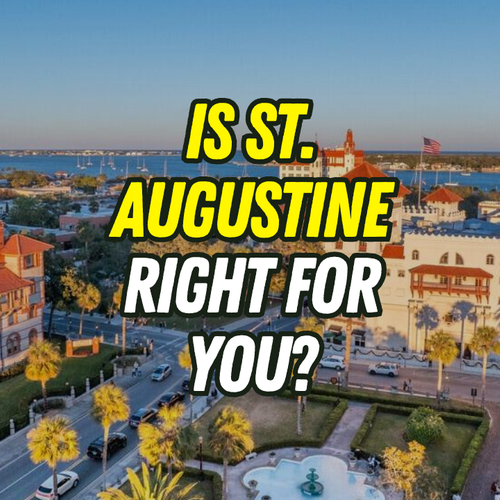
St. Augustine, Florida offers an appealing combination of beaches, historic character, outdoor living, neighborhood variety, mild winters, and strong schools—but it also comes with real trade-offs.
Tourism, traffic, summer humidity, hurricane season, insurance costs, flood exposure, rapid growth, and neighborhood-specific expenses can significantly affect your experience. Whether St. Augustine is worth it depends less on finding the perfect house and more on choosing the version of St. Augustine that fits how you actually want to live.
- Pro: Beaches, boating, historic downtown, golf, outdoor dining, and mild winters make the lifestyle a major attraction.
- Con: Millions of visitors create noticeable tourism, parking, and traffic pressure in popular areas.
- Pro: St. Augustine offers very different neighborhood and housing lifestyles within the same general area.
- Con: Choosing the wrong location can leave you farther from work, beaches, schools, or daily activities than expected.
- Pro: Florida has no state individual income tax, and St. Johns County schools are a major attraction for many families.
- Con: Insurance, flood risk, property taxes, HOA and CDD fees, climate, and continued growth can change the true cost and experience of living here.
The Lifestyle Is One of St. Augustine’s Biggest Advantages
The lifestyle is one of the strongest arguments for living in St. Augustine. You have the Atlantic Ocean, the Intracoastal Waterway, rivers, marshes, beaches, boating opportunities, golf, cycling, paddleboarding, fishing, and a historic downtown all within the broader St. Augustine area.
That makes it possible to build a lifestyle around being outside. A Saturday might include walking through downtown in the morning, eating lunch near the water, spending the afternoon at the beach, and ending the day at home on your patio.
Winter is another major advantage. Compared with colder parts of the country, St. Augustine can offer months when outdoor dining, golf, boating, walking, and beach trips remain realistic parts of everyday life. If your reason for moving to Florida is to spend more of the year outdoors, St. Augustine can deliver the lifestyle you probably have in mind.
The Trade-Off: You’re Not the Only Person Who Wants to Be Here
St. Augustine is also a major tourist destination. The video script cites a resident population of roughly 16,000 people while noting that the city attracts more than 3 million visitors annually. You can feel that popularity in the places visitors naturally concentrate. Downtown during Nights of Lights, the Bridge of Lions during major events, and the area around St. George Street on a busy weekend can feel very different from a quiet residential neighborhood.
The important distinction is that tourism does not affect every resident equally. Living close to downtown gives you convenient access to restaurants, attractions, and historic St. Augustine—but it also places you closer to where visitors want to be. Living farther west, farther north, or in certain residential areas of Anastasia Island may produce a completely different day-to-day experience.
The decision, therefore, is not simply whether tourism bothers you. It is how close you want to live to the activity that attracts tourists in the first place.
There Isn’t Just One Version of St. Augustine
One of St. Augustine’s most important advantages is variety. Two people can both say they live in the St. Augustine area and have dramatically different lifestyles.
You might choose Davis Shores and have the ability to bike across the Bridge of Lions toward downtown. You might prefer the more relaxed coastal atmosphere near Crescent Beach. You could choose an established neighborhood with mature landscaping and no CDD, or select a newer master-planned community with newer homes, pools, fitness facilities, trails, and other amenities.
That range creates options for buyers with very different priorities. But it also creates one of the most common relocation mistakes: choosing the house before choosing the lifestyle.
Why Starting With the House Can Be a Mistake
A kitchen, pool, floor plan, or extra bedroom can be easy to fall in love with online. What a property listing cannot always show you is what your normal Monday morning will feel like. Bridges, traffic patterns, commute direction, school zones, beach access, downtown access, and the places you visit every week can matter more than a home's individual features.
If you commute toward Jacksonville several days per week, location deserves significant weight. If the entire reason you are moving is to walk on the beach every morning, buying a larger home 30 minutes inland may undermine the lifestyle you wanted in the first place.
Likewise, someone who wants new construction and community amenities should probably approach the search differently than a buyer looking for mature trees, architectural character, fewer community restrictions, or no HOA.
A more useful relocation question is not simply, “What kind of house do I want?” It is, “What do I want my normal week to look like?” Once that answer is clear, the house search becomes much more focused.
No State Income Tax Does Not Mean Florida Homeownership Is Cheap
Florida's lack of a state individual income tax is a legitimate financial advantage for some people relocating from other states. Depending on where you currently live and what you earn, the difference can affect your overall financial picture.
But comparing home prices alone can be misleading.
Two homes priced at $450,000 can create very different monthly ownership costs depending on where they are located, how old they are, and which additional expenses apply.
Costs Buyers Should Evaluate Beyond the Purchase Price
Homeowners insurance is one example. The script cites an average of roughly $2,889 per year for St. Johns County homeowners with wind coverage and notes that costs can be higher near the water or when a home has an older roof. Depending on the property and flood zone, flood insurance may be another consideration.
Property taxes also need to be evaluated property by property. In some newer master-planned communities, you may encounter both an HOA and a CDD. A Community Development District, or CDD, is different from an HOA. As explained in the video script, the CDD is collected through the property tax bill and helps fund community infrastructure.
That distinction matters because looking only at an HOA fee can leave you with an incomplete understanding of the property's actual carrying costs. Then there are normal Florida ownership expenses. Air conditioning gets significant use during hot months. Pest control or lawn care may become part of your budget. Near the beach, salt air can accelerate deterioration of exposed metal and increase maintenance demands.
None of those expenses alone necessarily makes a home unaffordable. The issue is what happens when you stack them together. That is why a more useful number for many buyers is not simply the maximum purchase price they can qualify for. It is the total monthly payment and ownership cost they are actually comfortable carrying.
St. Johns County Schools Are a Major Draw, but Growth Matters
Schools are one of the strongest reasons some families consider St. Augustine and the surrounding St. Johns County area. The video script states that for the 2025–26 school year, St. Johns County School District reclaimed the number-one ranking in Florida, receiving an “A” grade with 910 out of 1,200 accountability points.
That performance has helped make the area attractive to families, particularly in northern St. Johns County and newer residential communities.
The challenge is that strong schools can also contribute to growth. More families mean more housing demand, more students, and increased pressure on schools, roads, and other infrastructure.
School Zones and Surrounding Development Can Change
The script describes new schools being built, attendance boundaries changing, and portable classrooms being used as the county grows. It also notes that nearly 2,000 students were being reassigned as two new K–8 schools opened. For a buyer, the practical lesson is important: if a specific school is central to your home search, verify the property's current assignment rather than assuming today's boundary will remain permanent indefinitely.
The same principle applies to development around your home. An area that feels quiet or rural today may look different years from now. If you are considering a home beside hundreds of acres of undeveloped land, understanding what may be planned nearby should be part of your research.
The question is not whether growth is automatically good or bad. The question is whether the direction of that growth aligns with the environment you want to live in.
St. Augustine Gives You Florida Weather, Including the Parts People Forget About
Mild winters are a significant lifestyle advantage for people moving from colder climates. Golf, boating, beach walks, and outdoor dining can remain part of your lifestyle through much of the year. Instead of spending several months waiting for warm weather to return, you can often continue outdoor activities during winter.
But St. Augustine is still Florida. July, August, and September can be hot and humid. Your air conditioning will work hard. Bugs are part of the climate. Salt air near the coast can be tough on metal and outdoor equipment.
And hurricane season runs from June through November. That does not mean every property floods or that residents evacuate every year. The more useful way to think about weather risk is property by property.
Flood Risk Is Specific, Not Universal
The video script specifically contrasts areas such as Davis Shores, Vilano, and parts of Anastasia Island with properties farther inland. Some coastal locations may involve a higher-hazard AE flood-zone conversation, while a Zone X property only a few miles away may present a different situation.
That is why blanket statements such as “St. Augustine floods” are not especially useful when evaluating a particular home. The better approach is to understand the exact property's elevation, flood-zone designation, available flood history, and insurance cost before making a decision.
That allows you to evaluate risk based on the property you are actually considering rather than fear based on the entire city.
Common Misconceptions About Living in St. Augustine
One misconception is that living in St. Augustine means constantly dealing with downtown tourist traffic. That depends heavily on where you live. Popular visitor areas can become crowded while many residential neighborhoods have a very different day-to-day rhythm.
Another misconception is that Florida is automatically inexpensive because it does not have a state individual income tax. Taxes are only one part of your overall cost of living. Insurance, CDD assessments, HOA fees, maintenance, flood considerations, utilities, and property taxes can substantially affect the monthly number. It is also easy to assume that choosing a highly rated school zone solves the school question permanently. In a rapidly growing county, attendance boundaries and school assignments may change as new schools are added.
Finally, St. Augustine should not be treated as one uniform housing market or lifestyle. Coastal neighborhoods, historic areas, established inland communities, and newer master-planned developments can provide very different experiences.
Important Considerations Before You Move to St. Augustine
Before focusing on listings, define the lifestyle you are trying to create. Think through where you will work, how often you will commute, how much proximity to downtown matters, whether regular beach access is important, whether you want community amenities, and how much maintenance you are comfortable handling.
Then evaluate the financial side at the property level rather than relying only on the asking price. Look at the complete monthly picture: mortgage payment, property taxes, insurance, possible flood insurance, HOA fees, CDD assessments, utilities, and likely maintenance.
If schools matter, verify the current school assignment. If surrounding growth matters, research what is planned nearby. If flood exposure matters, evaluate the exact property rather than making assumptions based on its ZIP code or neighborhood name.
The house still matters. But in St. Augustine, the location around the house can determine whether the move delivers the lifestyle you expected.
“We couldn’t be more grateful for our experience with Kristen! She was absolutely wonderful from start to finish. Kristen was professional, knowledgeable, responsive, and truly went above and beyond to make the entire home-buying process as smooth and stress-free as possible. She was always there to answer our questions, keep us informed, and make sure we felt confident every step of the way. You can tell she genuinely cares about her clients and wants the very best for them.
We are so thankful to have had Kristen by our side as we started this exciting new chapter and purchased our vacation home in Florida! We highly recommend Kristen to anyone looking for a realtor who is professional, trustworthy, caring, and truly dedicated to her clients.
She is absolutely amazing!”— Danielle M.
FAQ
Is St. Augustine, Florida a good place to live?
St. Augustine can be a strong fit if you want beach access, outdoor recreation, historic character, mild winters, a range of neighborhood styles, and access to highly regarded St. Johns County schools. It may be less appealing if you dislike heat, humidity, tourism, hurricane considerations, or the ownership costs associated with some Florida properties.
What should I know before moving to St. Augustine?
Start with your lifestyle instead of your house wish list. Commute direction, bridges, school zones, beach access, downtown proximity, flood exposure, HOA and CDD costs, insurance, and planned development can all influence whether a neighborhood works for you.
Is living in St. Augustine expensive?
It depends on the property. Two similarly priced homes can have very different monthly costs once you include property taxes, insurance, possible flood coverage, HOA fees, CDD assessments, air conditioning, maintenance, pest control, and lawn care.
Does St. Augustine have a flooding problem?
Flood exposure varies significantly by location and individual property. Some coastal areas have greater exposure, while homes only a few miles away may fall into different flood zones. Review the specific property's flood zone, elevation, history, and insurance requirements before buying.
So, Is Living in St. Augustine Worth It?
For the right person, St. Augustine offers a lifestyle that can be difficult to replicate: beaches, historic downtown access, outdoor recreation, mild winters, strong schools, and neighborhood choices ranging from coastal communities to newer master-planned developments.
But it is not the right fit for everyone. If you want a truly walkable big-city environment, strongly dislike heat and humidity, want to avoid tourist activity entirely, or assume Florida homeownership will automatically be inexpensive because there is no state individual income tax, the reality may not match your expectations.
The most important decision is not simply whether you should move to St. Augustine. It is which version of St. Augustine fits you.
Check out this article next