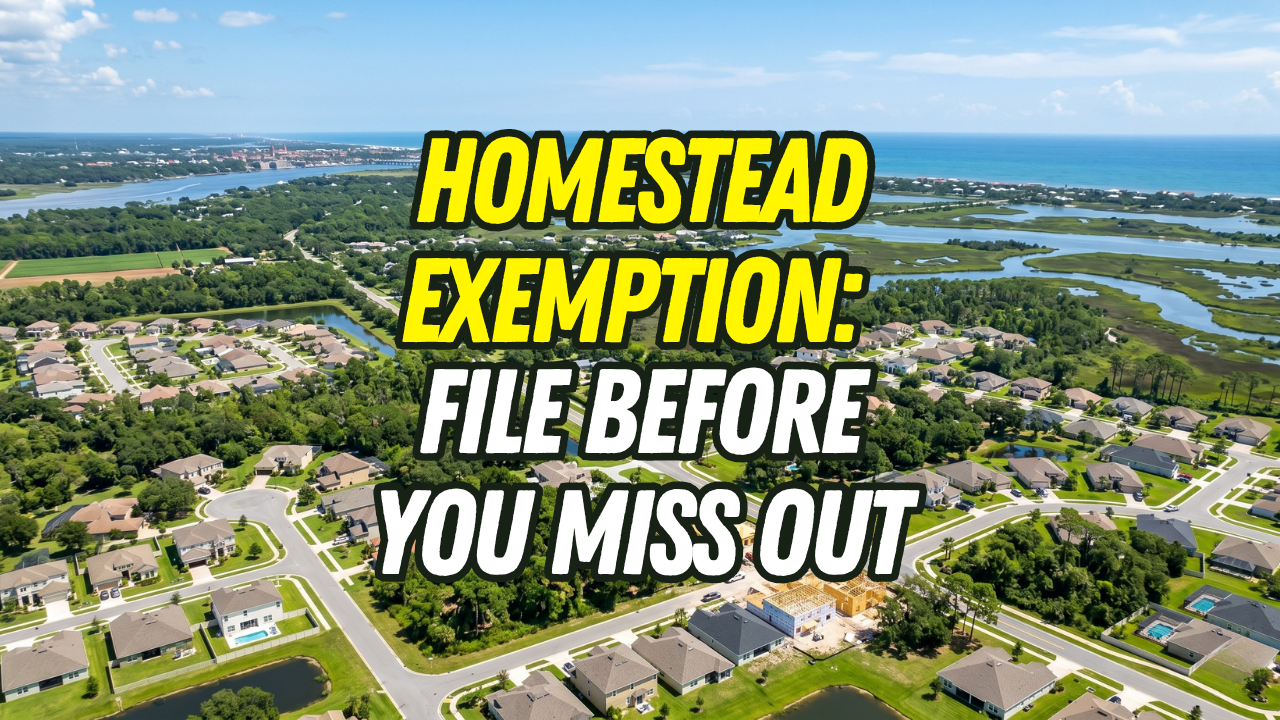
What is the Florida homestead exemption, and how much will you save in St. Johns County?
Florida's homestead exemption reduces the taxable value of your primary residence by up to $51,411, saving most St. Johns County homeowners between $700 and $1,200 per year on their property tax bill. To receive it, you must own and occupy the property as your primary residence as of January 1 and file a one-time application with the St. Johns County Property Appraiser by March 1 each year. The exemption does not transfer automatically from the previous owner—every new buyer must apply separately. If you missed the March deadline, late filing may still be available through the TRIM period (typically until late August) for just cause.
Every year I talk to buyers who close on their St. Johns County home in the fall, get settled in, and then realize months later — sometimes after receiving their first tax bill — that they never filed for homestead exemption. They assumed it happened automatically. It doesn't.
This is one of the most common and costly surprises for out-of-state buyers relocating to St. Augustine, Ponte Vedra, Nocatee, or anywhere else in St. Johns County. Florida's homestead exemption can save you $700 to $1,200 or more each year on your property taxes — but only if you apply. And there's a deadline.
Here's everything you need to know, including what to do if you already missed it.
What the Exemption Actually Does
The homestead exemption is a Florida constitutional protection (Article VII, Section 6) that reduces the taxable value of your primary residence. For 2026, the total exemption is $51,411, structured in two tiers:
- First $25,000: Applied to all property taxes, including school district taxes
- Second $26,411: Applied to the assessed value between $50,000 and $75,000 — but not to school district taxes
In plain terms: if your home is assessed at $500,000, you pay taxes on approximately $448,589 instead of the full $500,000. At St. Johns County's blended millage rate — which combines county, school board, and various special districts into a combined rate that typically runs 14 to 16 mills depending on your exact location — that's a meaningful reduction every single year.
For a $600,000 home in St. Johns County, the exemption typically saves homeowners somewhere between $700 and $1,200 annually. It's not a one-time discount. It compounds for as long as the property is your primary residence.
The Hidden Bonus: Save Our Homes Protection
Filing for homestead does more than lower your tax bill today. It also activates Florida's Save Our Homes (SOH) cap, which is arguably more valuable over time.
The SOH cap limits how much your assessed value can increase each year — to 3% or the Consumer Price Index change, whichever is lower. Once you've had homestead for one full year, your annual tax increases are constrained by that cap no matter how much your home's market value climbs.
Here's why that matters in St. Johns County specifically: this county has been one of the fastest-growing in the country. Property values have increased dramatically over the past decade, and that upward pressure is expected to continue. Without the SOH cap, your tax bill would track those increases closely. With it, your taxable assessed value grows at a small fraction of the rate your market value does.
Long-time homesteaders in communities like Nocatee, Ponte Vedra, and St. Augustine proper are sitting on assessed values that can be tens of thousands of dollars below their current market value — and that gap grows every year they stay. It's one of the most underappreciated financial benefits of Florida homeownership.
One critical note for buyers: when you purchase a home from a long-time owner, their SOH cap disappears. Your assessed value resets to just (market) value in the year following your purchase, and your own 3% cap begins accumulating from there. This is why some buyers in St. Johns County see a significant property tax increase in their second year of ownership — particularly when they bought from someone who had homestead for 10 or 15 years. It's not a mistake or an error. It's how Florida's system works. Your new cap starts building immediately after your first homesteaded year, and it will benefit you for every year you stay in the home.
Eligibility and What You Need to File
To qualify, you must own the property and occupy it as your primary residence as of January 1 of the tax year you're filing for. Seasonal or part-time residents do not qualify. The exemption applies to one property only — your primary home, not investment properties or vacation homes.
When you apply with the St. Johns County Property Appraiser, have these documents ready:
- Florida driver's license or state ID — updated to show your new home address
- Social Security numbers for you and your spouse, if applicable
- Florida vehicle registration — updated to your new address
- Florida voter registration — updated, if registered
- For non-US citizens: Permanent Residence card (green card), front and back
- For property held in trust: a complete copy of the trust agreement
Update your driver's license and vehicle registration to your new address before you apply. The property appraiser's office uses these documents to confirm that you're actually living in the home, not just holding title. If your license still shows your old address from Ohio or New York, your application can be delayed.
This is something I walk every relocation client through: getting all those Florida ID updates done in the first 30 days after closing sets you up to file cleanly when the time comes.
How to Apply and When
The St. Johns County Property Appraiser makes this straightforward. You have two options:
Online: Apply through the county's secure portal at hx.sjcpa.us/ApplyOnline. This is the fastest option for most buyers.
In person: Visit the office at 4030 Lewis Speedway, Suite 203, Saint Augustine, FL 32084. You can also call (904) 827-5500 or visit sjcpa.gov with questions.
The filing deadline is March 1 of the tax year in which you want the exemption to apply — meaning you must establish your residency by January 1 of that year. In 2026, the deadline shifted to March 2 because March 1 fell on a Sunday.
Once you're approved, you don't need to re-apply each year. The exemption renews automatically as long as the property remains your primary residence and your information doesn't change significantly.
| Key Detail | St. Johns County Specifics |
|---|---|
| Filing deadline (standard) | March 1 each year (March 2 in 2026) |
| Residency requirement | Must be primary residence as of January 1 |
| 2026 exemption amount | Up to $51,411 off taxable value |
| Estimated annual savings | $700–$1,200+ depending on millage area |
| Online application portal | hx.sjcpa.us/ApplyOnline |
| In-person address | 4030 Lewis Speedway, Suite 203, St. Augustine, FL 32084 |
| Phone | (904) 827-5500 |
| Late filing window | Through TRIM period (~late August / mid-September) for just cause |
Missed the March Deadline? You May Still Have Time
If you closed on your St. Johns County home in late 2025 and realized you never filed — or if life got busy and March slipped past you — don't assume you're out of luck for the year.
Florida law allows the Property Appraiser's office to accept late applications for just cause. That window stays open through the TRIM period, which typically runs through late August or mid-September (25 days after the county mails TRIM notices).
"Just cause" is broader than people think. You don't need a medical emergency or a natural disaster. Circumstances like moving in late in the year and not knowing the deadline existed, being unaware the exemption requires a separate application, or dealing with a significant life transition can qualify. The key is contacting the office proactively, explaining your situation clearly in writing, and providing documentation that supports your account.
Call (904) 827-5500 as early as possible. The office is generally helpful with buyers who make a good-faith effort. And if you're reading this in the spring or summer, there's a real chance you can still protect your exemption for the current tax year.
This is exactly the kind of thing I check in on with my clients after they close. It's one of those steps that doesn't come with a reminder from your lender or your title company — it just needs to happen. If you're a recent buyer in St. Johns County and haven't filed yet, reach out and I can point you in the right direction.
For more on what to expect in your first year as a Florida homeowner, the 10 things I tell every buyer before moving to St. Augustine covers the bigger picture — including the financial adjustments that catch out-of-state relocators off guard. And if you're still evaluating your options, my guide on the most costly homebuying mistakes relocating buyers make is worth reading before you sign anything.
"My husband and I were interested in moving to northeast Florida and began doing research of the area. We found Kim while watching YouTube videos of the area and found her and her videos informative and educational. We reached out to see if she could help us find our dream home in the St. Augustine/Palm Coast area. Right away, we connected with her. Kim listened to what we wanted and what was important to us. She asked questions to help us narrow our scope as we didn’t really know the area. Kim proactively reached out to us as we prepared for the move down and as soon as we settled here, we hit the ground running. Kim set up search criteria, suggested we drive through specific neighborhoods/areas to get a feel of the community, and immediately began showing us houses so we could see what was most important to us. Because of her strong network and actually living in the community herself, she is extremely knowledgeable of northeast FL. Kim was always courteous, professional, willing to answer any questions, and provided us with helpful tips. Kim’s biggest strength is her advocacy for her clients. She continuously offered advice and always had our best interest at heart. If you are looking for a property in northeast Florida, I highly recommend Kim Devlin. She is truly the BEST in the business." -Mary G.
Frequently Asked Questions
Does the homestead exemption automatically renew each year?
Yes. Once you're approved, the exemption renews automatically as long as the property remains your primary residence. You don't need to reapply unless your ownership or residency status changes — for example, if you rent the home out, purchase a different primary residence, or move out of state.
What happens if I miss the March 1 homestead exemption deadline?
In St. Johns County, the Property Appraiser's office can accept late applications for just cause through the TRIM period — typically until late August or mid-September. Contact their office directly at (904) 827-5500 to explain your situation and submit a written request with supporting documentation. The sooner you reach out after missing the deadline, the better.
How long does the homestead exemption application take to process?
Processing times vary, but approvals are typically confirmed before the summer TRIM notices go out in August. If you apply online through the St. Johns County Property Appraiser's portal, you'll receive a confirmation and can check your status at sjcpa.gov.
Can I get the homestead exemption if my property is held in a trust?
Yes, but you must include a complete copy of your trust agreement with your application. The trust must satisfy Florida's requirements under F.S. 196.041, and you must be both the equitable owner and the primary occupant of the property.
How much does the Save Our Homes cap save Florida homeowners over time?
It depends on how long you stay and how much your home appreciates. In St. Johns County, where values have grown significantly over the past decade, long-time homesteaders often have assessed values well below current market values — sometimes by $100,000 or more. That gap compounds every year you remain in your home and pays off particularly well in high-growth markets like this one.
Filing for homestead exemption is one of the first things I encourage every buyer to do after closing in St. Johns County. It's free, it's worth hundreds of dollars a year, and the Save Our Homes protection it activates grows more valuable the longer you own your home. If you're relocating to St. Augustine, Palm Coast, or St. Johns County and want a head start before you arrive, grab the free St. Augustine Relocation Guide — it covers neighborhoods, costs, what to expect from the market, and everything you need to make a confident move. Download it here.
Check out this article next