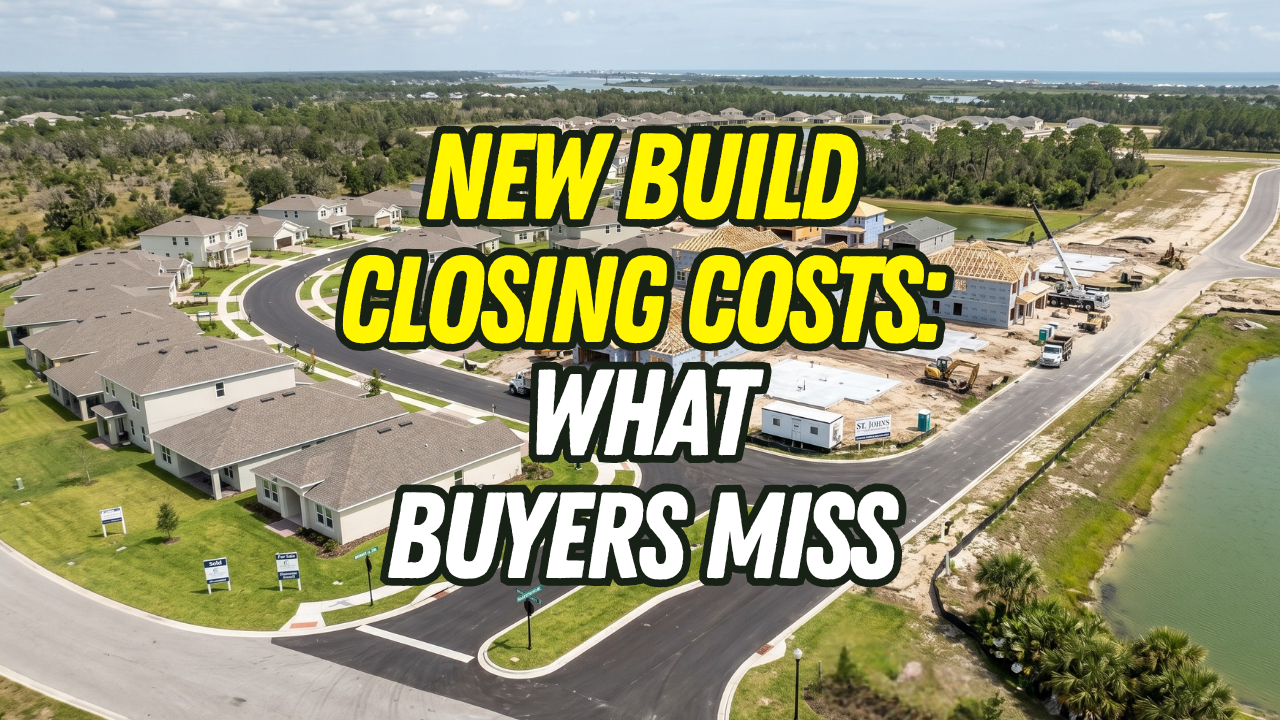
What are the closing costs for buying new construction in St. Johns County, Florida?
New construction buyers in St. Johns County typically pay more at closing than resale buyers — and the costs are structured very differently. On a new build, you'll pay Florida documentary stamp taxes on the deed, doc stamps on your mortgage note, intangible tax on your new loan, and owner's title insurance. On a resale, sellers typically cover most of those same costs. On a $650,000 new construction home with a $520,000 loan, those four items alone can add $10,000 or more to your cash needed at closing — before lender fees, prepaid insurance, or tax escrows even enter the picture.
One of the most common surprises I see with relocation buyers — especially those coming from out of state — happens at closing on a new construction home.
They've budgeted for the down payment. They've accounted for the builder's closing cost credits (if they got any). They've seen the loan estimate. And then they get to the final closing disclosure and the numbers don't match what they expected.
The reason, almost every time, is the Florida-specific cost structure for new builds. It's not complicated once you know it, but most buyers don't know it until they're sitting at the title company table.
Here's what you actually need to budget for.
The Core Difference Between New Construction and Resale in Florida
In a standard resale transaction in Northeast Florida, the seller pays a significant share of the closing costs — including the owner's title insurance policy and the documentary stamp tax on the deed. That's just how it's typically structured here, and it's one reason Northeast Florida is actually more seller-pays-heavy than many other regions.
New construction flips that.
Builder contracts in Florida almost universally require the buyer to pay costs that a seller would cover on a resale. Your builder's contract will spell this out, but most buyers don't flag it because it's buried in boilerplate and the numbers aren't calculated until you're deeper into the process. Here's what you'll be paying.
Documentary Stamp Taxes on the Deed
Florida charges a documentary stamp tax every time a property deed changes hands. The rate is $0.70 per $100 of the purchase price across all counties except Miami-Dade.
On a resale: The seller pays this. It comes out of their proceeds.
On new construction: The builder's contract shifts this to the buyer. On a $650,000 home, that's $4,550 — due at closing, as part of your cash-to-close.
Documentary Stamp Taxes on the Mortgage Note
If you're financing the purchase, Florida charges a separate doc stamp tax on your mortgage promissory note — $0.35 per $100 of the loan amount.
This one applies to all purchases, resale and new construction alike. The buyer always pays.
On a $520,000 loan, that's $1,820 at closing.
Florida Intangible Tax on the New Mortgage
Florida also charges a one-time intangible tax on new mortgage loans. The rate is 0.20% of the loan amount.
Again, this applies to all financed purchases — not just new construction. The buyer always pays.
On a $520,000 loan, that's $1,040 at closing.
Owner's Title Insurance
Title insurance protects your ownership rights if a claim against the property surfaces later. There are two policies: the owner's policy (which protects you) and the lender's policy (which protects your bank).
On a resale in Northeast Florida: The seller pays for the owner's title insurance policy. It's standard practice here, and it saves buyers a meaningful amount.
On new construction: The builder requires the buyer to pay for the owner's policy — and often requires you to use their preferred title company. On a $650,000 home, the owner's title insurance policy typically runs $2,500–$3,200 depending on the premium schedule.
The lender's title insurance policy is always the buyer's responsibility — roughly $750–$1,000 on most transactions in this price range.
What Does This Add Up To?
Here's a realistic example for a $650,000 new construction home in St. Johns County with a $520,000 mortgage (20% down):
| Cost Item | Who Pays | Estimated Amount |
|---|---|---|
| Doc stamps on deed ($0.70/$100) | Buyer (new construction) | $4,550 |
| Doc stamps on mortgage ($0.35/$100) | Always buyer | $1,820 |
| Intangible tax on mortgage (0.20%) | Always buyer | $1,040 |
| Owner's title insurance | Buyer (new construction) | ~$2,800 |
| Lender's title insurance | Always buyer | ~$850 |
| Subtotal — these five items | ~$11,060 |
And that's before your lender's origination fees, prepaid homeowner's insurance, property tax escrow deposits, HOA setup fees, and any other transaction-specific costs.
A realistic total closing cost estimate for a new construction home in the $600K–$750K range in St. Johns County is $18,000–$30,000 or more, depending on your loan program, lender, and builder incentives.
This is why I always walk my relocation clients through a projected cash-to-close number before they sign a builder contract — not after. By then, it's too late to adjust your budget.
Builder Credits Can Help — But Read the Fine Print
Many builders in St. Johns County — particularly in communities across St. Johns, Ponte Vedra, and along the growth corridors toward Palm Coast — are offering closing cost credits or interest rate buydowns as buyer incentives. These can be genuinely valuable.
But here's what to know: builder credits are almost always contingent on using the builder's preferred lender. If you choose an outside lender, you typically lose the credit. And the builder's lender may or may not offer you the most competitive rate.
Before you accept a builder credit tied to a lender, it's worth getting a competing quote to see whether the rate difference costs you more over the life of the loan than the credit saves you at closing. Sometimes the builder's package wins. Sometimes it doesn't.
Two More Things New Construction Buyers Often Miss
CDD Assessments. Many new construction communities in St. Johns County have a Community Development District — a special tax district that finances infrastructure like roads, utilities, and common areas. The CDD assessment appears as a separate line item on your property tax bill and typically runs $1,000–$3,000 per year, depending on the community. I wrote a full breakdown of how CDDs work in What is a CDD Fee? and St. Johns County CDD Fees Explained.
Year-One Property Taxes. Your first property tax bill on a new build is often assessed on the vacant lot — because the home wasn't standing on January 1, the county assessment date. The second year's bill reassesses to the full improved value. If your lender is escrowing taxes based on the first year's lower bill, you may have an escrow shortfall in year two.
How to Protect Yourself Going In
- Ask for a projected closing disclosure before signing the builder contract. The builder's preferred title company can produce this estimate early. If they won't, that's a red flag.
- Get your own mortgage quote. Even if you end up using the builder's lender, knowing the comparison gives you negotiating power.
- Have an agent review the purchase agreement before you sign. Builder contracts are written to protect the builder. Having someone in your corner who understands the St. Johns County market can help you catch terms that could cost you later.
Frequently Asked Questions
Do buyers always pay doc stamps on new construction in Florida?
In Florida, the documentary stamp tax on the deed is technically the seller's obligation by default — but builder contracts almost universally shift this cost to the buyer. On a resale transaction in Northeast Florida, the seller typically pays the deed doc stamps; on new construction, budget for the buyer to pay them.
What is Florida's intangible tax and who pays it?
Florida charges a one-time intangible tax of 0.20% on new mortgage loans. On a $500,000 loan, that's $1,000 due at closing. This applies to all financed purchases and is always paid by the buyer (borrower).
Does the builder have to use a specific title company in Florida?
In Florida, builders routinely require buyers to use their designated title company as a condition of the sale. You can choose your own title company for a resale.
Who pays owner's title insurance on a new construction home in St. Johns County?
On resales in Northeast Florida, the seller pays the owner's title insurance premium. On new construction, the buyer pays — it's written into the builder's purchase contract.
Can the builder's closing cost credits cover these costs?
Sometimes, yes — but credits are typically tied to using the builder's preferred lender, and they don't always cover the full amount. Always request an itemized estimate.
If you're relocating to St. Augustine, Palm Coast, or St. Johns County and want a head start before you arrive, grab Kim's free St. Augustine Relocation Guide. Download it here.
Check out this article next