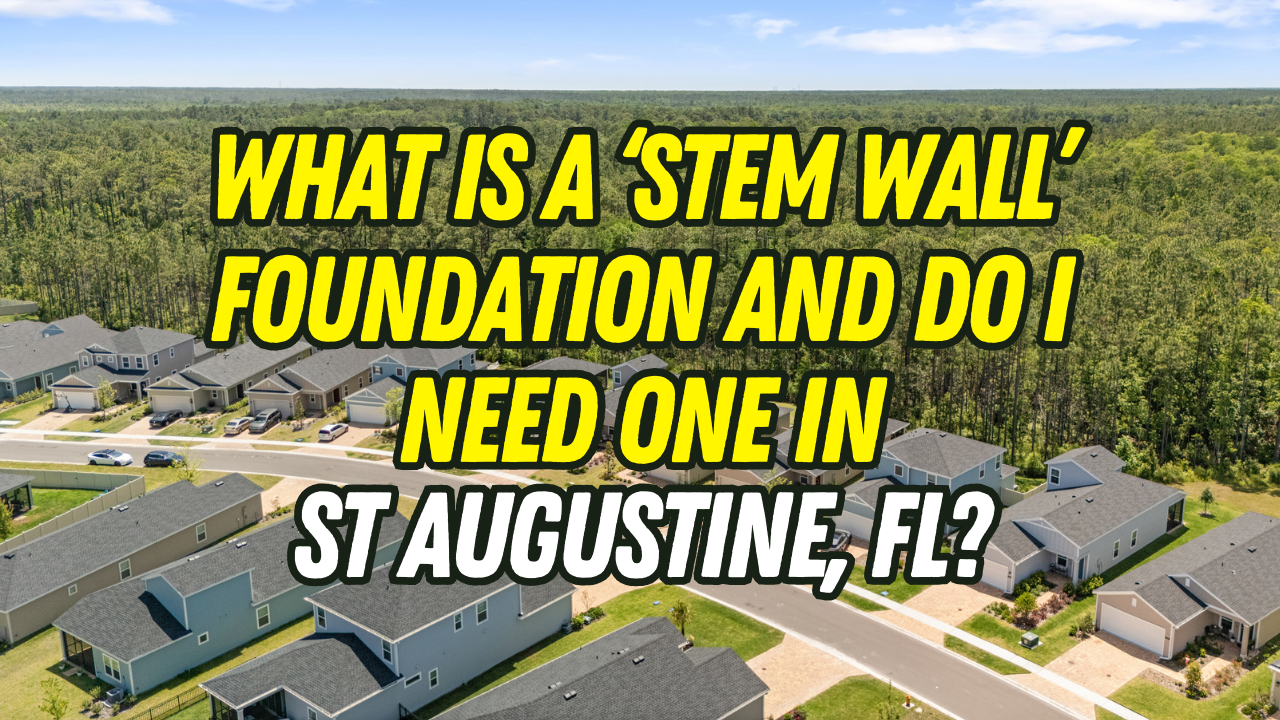
A stem wall foundation is a concrete wall that sits on a concrete footing and supports the home above grade—often with a slab poured inside the perimeter. In St. Augustine, whether you “need” one depends on your lot’s elevation goals, flood and drainage considerations, soil conditions, and what an engineer designs for that specific site.
- Stem wall = concrete wall on a footing that raises the home’s structure above grade.
- It’s commonly used to gain elevation, manage site drainage, and create separation from moisture-prone ground conditions.
- In St. Augustine, the “right” foundation often comes down to water table, flood risk, grading, and engineering.
- No foundation type is universally required—the best choice is lot-specific and plan-specific.
- Buyers should evaluate total cost + long-term performance, not just the build method.
If you’re buying new construction—or evaluating a home’s structure during inspections—you’ll hear foundation terms that sound technical but matter a lot in real life. “Stem wall” is one of them. Here’s the practical way to think about it: a stem wall foundation is often chosen when a home needs to sit a bit higher than the surrounding grade, or when the builder wants a more controlled transition between the soil and the structure. That can be especially relevant in areas where water management and moisture exposure are part of everyday reality. St. Augustine has a mix of coastal influence, variable lot elevations, and moisture considerations that can affect foundation decisions. The goal is not to pick the “best” foundation in theory—it’s to choose the foundation that performs best on your lot and matches the home’s elevation, drainage, and structural requirements.
What a Stem Wall Foundation Actually Is (Plain English)
A stem wall is a reinforced concrete wall built on top of a concrete footing. The footing spreads the home’s load into the soil, and the stem wall raises the structure above the surrounding ground level. In many builds, the slab is then poured inside the stem wall perimeter (often called a “monolithic slab” when poured together, or “stem wall + slab” when staged). The exact configuration varies by engineering design and site plan. What this changes for you:
- Elevation control: It can help raise finished floor height.
- Moisture separation: More distance between living space and wet ground conditions.
- Grade/drainage flexibility: Helpful when lot grading needs to move water away efficiently.
When a Stem Wall Often Makes Sense in St. Augustine
In St. Augustine, foundation choice often becomes a water-and-elevation conversation. A stem wall can be a strong option when the site benefits from getting the structure up and out of harm’s way—whether that’s routine stormwater, yard saturation after heavy rain, or broader flood-related planning. A stem wall is commonly considered when:
- Your lot needs a higher finished floor elevation for practical (or required) reasons.
- The site has drainage challenges and you want more control over grade transitions.
- You’re trying to reduce the risk of moisture intrusion at the living-floor level.
- The home design (or soil report) points toward a foundation system that benefits from a perimeter wall.
Important note: a stem wall doesn’t replace good site work. You still need proper grading, downspout discharge planning, and drainage paths that move water away from the home.
When You Might Not Need a Stem Wall
You don’t automatically “need” a stem wall just because you’re in St. Augustine. Many homes perform perfectly well on other foundation types depending on the lot, construction details, and engineering. You may not need a stem wall if:
- The lot is already well-elevated and drains efficiently.
- The engineering design supports an alternative foundation that meets performance needs.
- Cost tradeoffs don’t make sense for your goals (initial build cost vs. long-term value).
The key is not the label (“stem wall” vs “slab”). The key is whether the foundation system meets the home’s elevation and structural requirements and handles water realistically for that site.
“Your Key To St Augustine, Kim Devlin Team, exceeded our expectations!! From our first intro with YouTube videos explaining the area, a customized self-guided tour exploring many areas in St Johns County, narrowing down homes, doubling back to re-look at homes, making an offer, inspection, walk through, to the close -kim Devlin Team was with us !! We have had to relocate often for work and this is the BEST experience we have ever had!!!! THANK YOU” — Anne M.
Misconceptions and Key Points Buyers Get Wrong
- “Stem wall is always better.” Not true. Better depends on the lot, elevation goals, and engineering design.
- “Stem wall means no water issues.” A foundation can help, but grading, drainage, and waterproofing details matter just as much.
- “Foundation type is the only thing insurers care about.” Insurance often comes down to broader risk factors plus documented mitigation (roof, openings, structural details), not just foundation type.
- “If the builder chose it, it must be required.” Sometimes it’s required by design constraints; sometimes it’s a performance choice; sometimes it’s a cost/standardization choice.
Important Considerations Before You Decide
If you’re a buyer evaluating a home (or selecting a new construction plan), these are the questions that actually protect you:
- Elevation and flood planning: What elevation is the home built to, and why?
- Drainage plan: Where does water go during heavy rain—and does the site grade push it away?
- Moisture detailing: What damp-proofing/waterproofing is used on concrete and penetrations?
- Documentation: Are engineering plans, permits, and inspections properly documented?
- Inspection focus: Have an inspector look at cracks, control joints, slab edges, and water management details—not just the foundation label.
Bottom line: the “right” foundation is the one that is engineered for your lot, built correctly, and supported by a realistic water-management plan.
“I cannot say enough about how helpful Kim and her team have been! We closed on our house today and she was there from beginning to end. She was so responsive when we called with questions and jumped in to troubleshoot when unexpected issues arose. Kim and her team went above and beyond to insure the process to closing was smooth and complete. We are very grateful for how available and helpful she was in making this transition so smooth for us. I would recommend Kim and her team without reservation if you are looking to buy a new home in this area!” — Anne L.
FAQ
Is a stem wall better than a slab in St. Augustine? Not automatically. A stem wall can help elevate the structure and manage moisture on some sites, but the best foundation depends on elevation targets, soil/drainage, flood considerations, and an engineer’s design. Does a stem wall reduce flood or water problems? It can help by raising finished floor elevation and creating separation from grade, but it’s not a cure-all. Proper site grading, drainage, and code-compliant elevation planning matter just as much. What should I ask my builder or inspector about the foundation? Ask how the foundation choice meets elevation needs, how water is directed away from the home, what waterproofing/damp-proofing is used, how reinforcement is handled, and whether key mitigation details are documented.
Next Steps
If you'd like help navigating this topic, reach out to the Kim Devlin Team, your qualified real estate professional or continue exploring helpful resources!
Check out this article next